CarMax or Carvana for Indianapolis Used Car Buyers
From the lots on Lafayette Road and Shadeland Avenue to Carvana's vending machine and your driveway, here's what actually differs for an Indy buyer.

From the lots on Lafayette Road and Shadeland Avenue to Carvana’s vending machine and your driveway, here’s what actually differs for an Indy buyer.
If you’re shopping for a used car in Indianapolis right now, two platforms keep appearing at the top of your search results alongside the traditional dealership strips on 96th Street and Shadeland Avenue: CarMax and Carvana. Both promise fixed, no-haggle pricing. Both have enough inventory to challenge Andy Mohr, Tom Wood, and the major CPO lots. And both have enough marketing muscle to make their differences seem smaller than they are.
They aren’t small. For an Indianapolis buyer specifically, the gap between these two platforms matters in real dollars and real legal exposure. Return policy. Inspection access. Delivery logistics. Financing structure. Each one shifts the equation — sometimes by more than you’d expect. This piece is built on current local data, not recycled national reviews, and it’s designed to give you a methodology you can replicate yourself, not just a verdict to take on faith.
One thing worth knowing upfront, because it colors everything that follows: Indiana has no used-car lemon law. The state’s Lemon Law, codified at IC 24-5-13, covers new vehicles only. Once you drive a used car off any lot — CarMax, Carvana, or any independent dealer on Washington Street — your protection is whatever’s written into your purchase contract. That changes the weight of every policy detail below. More on why that matters when we get to return windows.
Who Is Actually Operating in Indianapolis
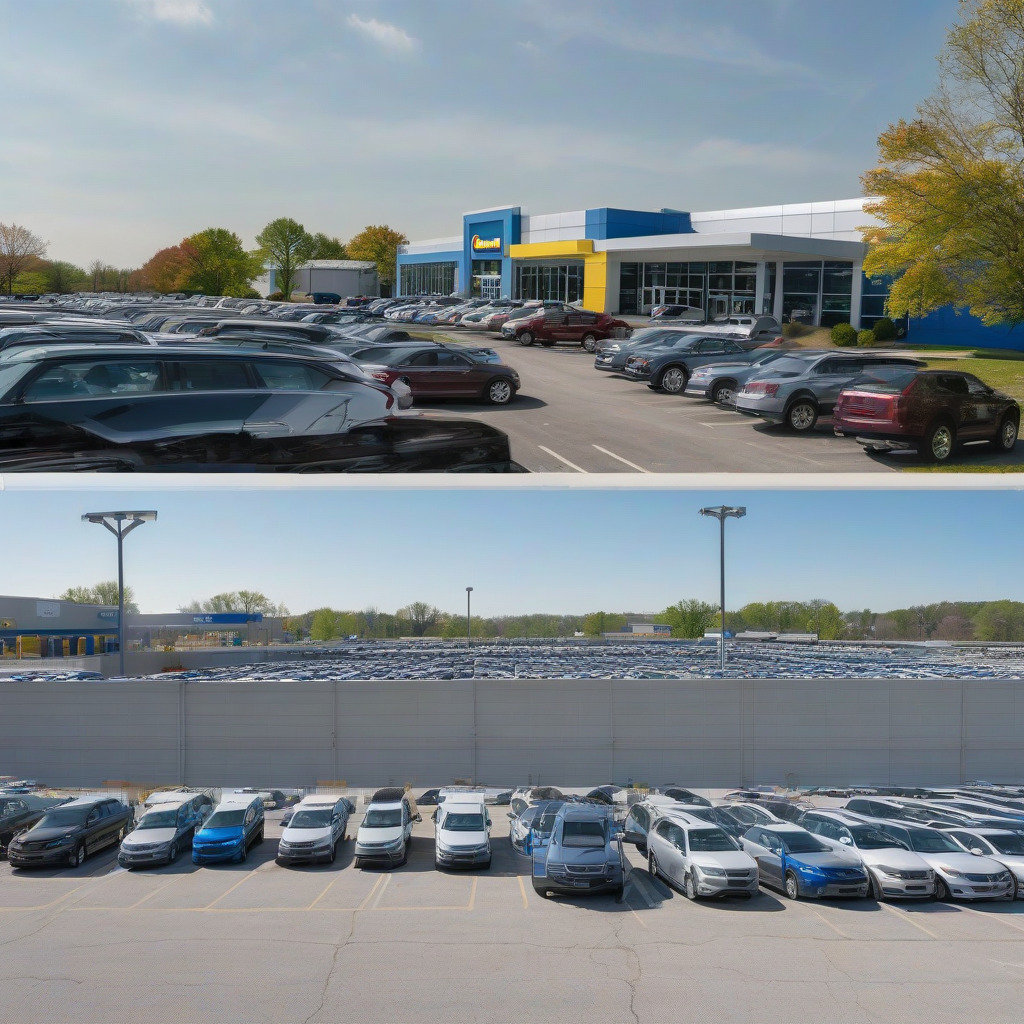
CarMax runs two physical locations in the Indianapolis market. The northwest location sits near the I-65/Lafayette Road interchange, in the commercial corridor you’ll recognize from the drive toward Traders Point or up toward Zionsville. The east-side location is near Shadeland Avenue and I-70, clustered with the other large used and new-car dealers on that stretch. Individual CarMax stores in this market typically stock somewhere between 150 and 300 vehicles on-lot, with additional inventory available for transfer from other regional locations. Pull live counts at carmax.com before making the drive — stock moves fast, and what’s listed Monday may not be there Friday. Walk-in test drives don’t require an appointment, though CarMax suggests scheduling one.
Carvana’s Indianapolis presence is structured completely differently, and if you haven’t looked closely at how the model works, it’s easy to misread. The Carvana vehicle vending machine near the I-69 corridor in the Castleton area exists, but check its current operational status at carvana.com before you make any plans around it. Here’s what it is not: a showroom. It’s not a place to browse or talk to anyone. It’s a vehicle pickup point for buyers who’ve already completed their purchase online and prefer to collect their car there rather than schedule home delivery. You cannot walk in, browse, or ask anyone to show you anything. I’ve heard from more than one buyer who drove out there expecting something like a CarMax lot. Don’t do that.
Pricing: How to Run a Live Comparison on a Common Indianapolis Vehicle
Use a 2020 Honda CR-V EX with 35,000–50,000 miles as your comparison vehicle. It’s one of the most frequently traded vehicles in this market and consistently appears on both platforms — a useful baseline precisely because it’s so common. Search the same year, make, model, and mileage range on both platforms on the same day and note the out-the-door price each provides.
The real comparison is in the fees underneath the sticker. CarMax charges a documentation fee and no delivery fee for local lot pickups. Vehicle transfers from other locations have historically run around $299 in many markets, though verify that directly with the store. Carvana charges a documentation fee and absorbs the home delivery cost — no separate delivery line item for Indianapolis-area buyers. Vending machine pickup is also free.
Both platforms are subject to Indiana’s 7% sales tax on the sale price, plus BMV title and registration fees. Title fees have run roughly $15–$30 in Indiana; registration varies by vehicle weight and county. Check current figures at in.gov before finalizing your budget. These fees apply equally no matter which platform you use.
The sticker price alone is rarely the differentiator. The fees and your financing rate are where the actual gap opens. Run the out-the-door calculators on both platforms for the same vehicle on the same day. Add the transfer fee if the CarMax vehicle you want isn’t sitting on a local lot. Skip this step and you’ll be puzzled when the monthly payment doesn’t match your expectations.
Inspection: What You Can and Cannot Do Before You Commit
At either CarMax Indianapolis location, you can walk in, ask to see any vehicle on the lot, and take it for a test drive. The sales process is genuinely low-pressure — I know that sounds like something lifted from a press release, but it’s accurate in my experience. This is CarMax’s clearest operational advantage over Carvana for any buyer who wants hands-on assessment before committing.
Carvana offers no pre-purchase inspection before delivery. The vending machine location is not a showroom. You will not be able to test drive or inspect the vehicle before you complete the purchase online. Carvana provides an inspection report, odometer disclosure, Carfax history report, and 360-degree photos for each listing. For a buyer who has done serious research and is confident in a specific vehicle, those disclosures may be enough. For a buyer who wants eyes and hands on a car before signing, they’re not a substitute for a test drive.
There is a workaround. Have a mobile mechanic come to you within the first few days of delivery. If they find something material, you initiate the return. This works — but it requires moving fast inside a tight window and absorbing the mechanic’s fee yourself if everything checks out. It’s a reasonable workaround, not a comfortable one. Anyone who wants physical access before committing should use CarMax. For a breakdown of how Indianapolis’s independent repair shops handle mobile inspections and post-purchase assessments, that’s worth a read before you schedule anyone.
Return Policies and Why Indiana’s Legal Situation Makes Them Critical
CarMax offers a 30-day / 1,500-mile return window. Buy a vehicle, drive it for three weeks, discover a persistent mechanical issue — you can return it for a full refund, no restocking fee, no explanation required. Carvana offers 7 days / 400 miles.
Seven days sounds like enough time for obvious problems. For intermittent ones, it isn’t. A check engine light that only appears under specific conditions. An HVAC issue that doesn’t surface until a cold morning — and if you’re buying in late fall in Indianapolis, you might not even get a cold morning in your first week. A transmission concern that only shows up on sustained highway miles. These are exactly the problems that don’t announce themselves immediately, and seven days is a short runway for finding them.
In states with strong used-car consumer protection statutes, the 23-day gap between these windows might matter less — a buyer could have additional legal remedies if a serious defect surfaced after the return window closed. Indiana doesn’t work that way. Once the window shuts, your protection is limited to whatever warranty coverage you’ve purchased and your ability to pursue a civil claim under general consumer fraud law. That’s a significantly harder road than a statutory lemon law claim, and most buyers aren’t going to walk it. The 23-day difference between CarMax and Carvana carries more weight here than it would in most other states. I’d call it the single most important difference on this list for Indiana buyers.
On extended warranties: CarMax’s MaxCare program is administered in-house and covers a wide range of mechanical failures, available in multiple term and deductible configurations. Because CarMax handles claims through its own service network, the process is relatively clean. Carvana partners with third-party warranty providers — coverage exists, but you’re dealing with a separate company on claims, not the platform itself. Read the terms on either. More importantly, read the exclusions list. That’s where these contracts tend to get creative.
Financing: Rates, Lenders, and What the Monthly Payment Actually Looks Like
CarMax finances through its own lending arm, CarMax Auto Finance, and also works with a network of third-party lenders. Apply for financing at a CarMax location and the system shops multiple lenders simultaneously and presents options. Pre-qualification is available online through a soft credit pull before you walk in.
Carvana finances primarily through Bridgecrest, a lender affiliated with Carvana’s parent company, DriveTime. This relationship is disclosed, but understand what it means: Carvana does not shop your application across independent lenders. You’re getting one lender’s offer, delivered through a clean interface. Carvana offers pre-qualification via soft credit pull, and the quoted rate is built into the online purchase flow.
Both platforms have been advertising starting APRs in the 6–9% range for well-qualified buyers, though rates shift with the broader environment and whatever either platform is doing promotionally in a given month. Your specific offer will depend on your credit profile. For an Indianapolis buyer near Marion County’s median household income — roughly $52,000–$55,000 — even a one- to two-percentage-point APR difference on a $25,000 vehicle translates to real money over 60 months. Run the numbers with each platform’s payment calculator before accepting any financing offer.
Both platforms accept outside financing. If you’ve secured a pre-approval from Purdue Federal Credit Union, Elements Financial, or another local lender, you can bring that rate to either platform. Spending 20 minutes applying at a local credit union before accepting either platform’s financing offer gives you a concrete benchmark — and in the current rate environment, local credit unions have sometimes offered more competitive terms than the lenders tied to these platforms. Our coverage of what Indianapolis used car buyers are actually facing this summer has more on how the current financing environment is playing out across the market.
Trade-In: Where the Real Money Is Often Hidden
Trade-in value is where buyers most often lose money without realizing it, usually because they accept the first number they see and move on.
Use a 2019 Ford F-150 XLT with approximately 60,000 miles as your test case. The F-150 consistently tops search results on every platform in this market — truck demand in Indianapolis stays strong year-round. Run it through both platforms’ online offer tools on the same day. Neither platform consistently beats the other across all scenarios. The only way to know which pays more for your specific vehicle is to run both quotes and compare. There’s no shortcut.
CarMax’s process is in-person: bring the vehicle to either Indianapolis location, an appraiser inspects it, you get a written offer. That offer is usable independently — you don’t have to buy from CarMax to sell to CarMax. Carvana’s is entirely online: complete the questionnaire, get an instant offer, redeem it at vending machine pickup or apply it as credit toward your purchase at delivery. Carvana also buys vehicles outright without a purchase on your end.
Running both quotes takes about 15 minutes and could recover several hundred dollars depending on your vehicle’s condition and where the market sits that week. Do it before you accept either platform’s number as your floor.
Delivery Logistics Across the Indianapolis Metro
Indianapolis’s spread-out geography works reasonably well for Carvana’s delivery model. For most Indianapolis-area zip codes, the company quotes delivery in roughly 2–7 business days depending on inventory location and transport. Test your specific zip code at carvana.com for a current window. Hendricks County and Johnson County buyers — Avon, Plainfield, Greenwood, Whiteland — sit far enough from CarMax’s two locations that home delivery is a genuine convenience, assuming you’ve already settled on a specific vehicle and don’t need to inspect it first. That assumption is doing some heavy lifting.
For buyers closer to CarMax’s locations — northwest side, east side, or inside the I-465 loop — the convenience gap narrows considerably. The drive is short, and the ability to test drive and get an in-person trade-in appraisal becomes more valuable.
CarMax’s vehicle transfer option matters for inventory not currently on local lots. If the vehicle you want is sitting at a CarMax in Cincinnati or Louisville, you can request a transfer. The fee has historically been around $299 in many markets — confirm the current figure with the store. Allow 5–10 business days. That’s comparable to, and sometimes longer than, Carvana’s delivery window from its distribution network. If you’re waiting for a specific vehicle to arrive either way, the platforms are closer in timeline than they look. The transfer fee is the real variable in that scenario.
Which Scenario Favors Each Platform for an Indy Buyer
CarMax is the stronger fit when:
You want to test drive before committing. You’re trading in a vehicle and want an in-person appraisal. You’re financing and want your application shopped across multiple lenders rather than funneled through an affiliated one. You want 30 days and 1,500 miles to discover a problem — which matters more in Indiana than in states with real used-car consumer protection. You’re not sure exactly what you want and need to walk a lot and compare vehicles physically.
Carvana is the stronger fit when:
You know exactly what you want — specific year, trim, mileage range — and you’ve done enough research to trust the photos and inspection report as your primary due diligence tools. You have a plan to get a mobile mechanic out quickly if something feels off after delivery. You live in the outer suburbs, where driving to either CarMax location is a genuine inconvenience. You’ve already secured outside financing and don’t need either platform’s lending. The ability to complete the entire purchase from your house, on your schedule, is worth something real to you.
One more thing before you transact: Carvana went through significant financial restructuring in 2022 and 2023. The company is operating, but check recent buyer reviews specific to the Indianapolis market before you commit. Look specifically at delivery reliability and title processing times. These are the details that slip during operational stress, and a 7-day return window doesn’t help much if the title takes six weeks to arrive. For context on how to transfer your out-of-state car registration after a purchase that crosses state lines, that process is worth understanding in advance if your chosen vehicle is coming from outside Indiana.
The Indianapolis used-car market is competitive enough that neither platform has a consistent pricing advantage over the other in most vehicle categories. The real differences are procedural — how much you can see before you commit, how long you have to change your mind, who’s lending you the money and at what rate. In a state without used-car lemon law protection, those procedural details carry more weight than they would almost anywhere else.
Run the trade-in quotes on both platforms. Price the same vehicle on both on the same day. Decide based on your specific geography and your comfort with buying a car you haven’t sat in. That’s the whole methodology.
For more local coverage, explore our Automotive section.