What a Home EV Charger Actually Costs in Indianapolis After Rebates
If you've been putting off installing a Level 2 charger because you're not sure whether you're looking at a $400 job or a $4,000 job, that uncertainty is justified. The range is genuinely that wide…

If you’ve been putting off installing a Level 2 charger because you’re not sure whether you’re looking at a $400 job or a $4,000 job, that uncertainty is justified. The range is genuinely that wide. Most of what determines where you land is specific to your house, your neighborhood, and which Marion County electrician you call first.
This piece does one thing: gives you the actual Indianapolis numbers. Five licensed electricians quoted us their rates. We pulled the current AES Indiana rebate terms. We called the Marion County Development Services office about permit timelines. Every figure below is traceable to a local source.
A Real Install to Start With: One Irvington Homeowner’s Itemized Bill
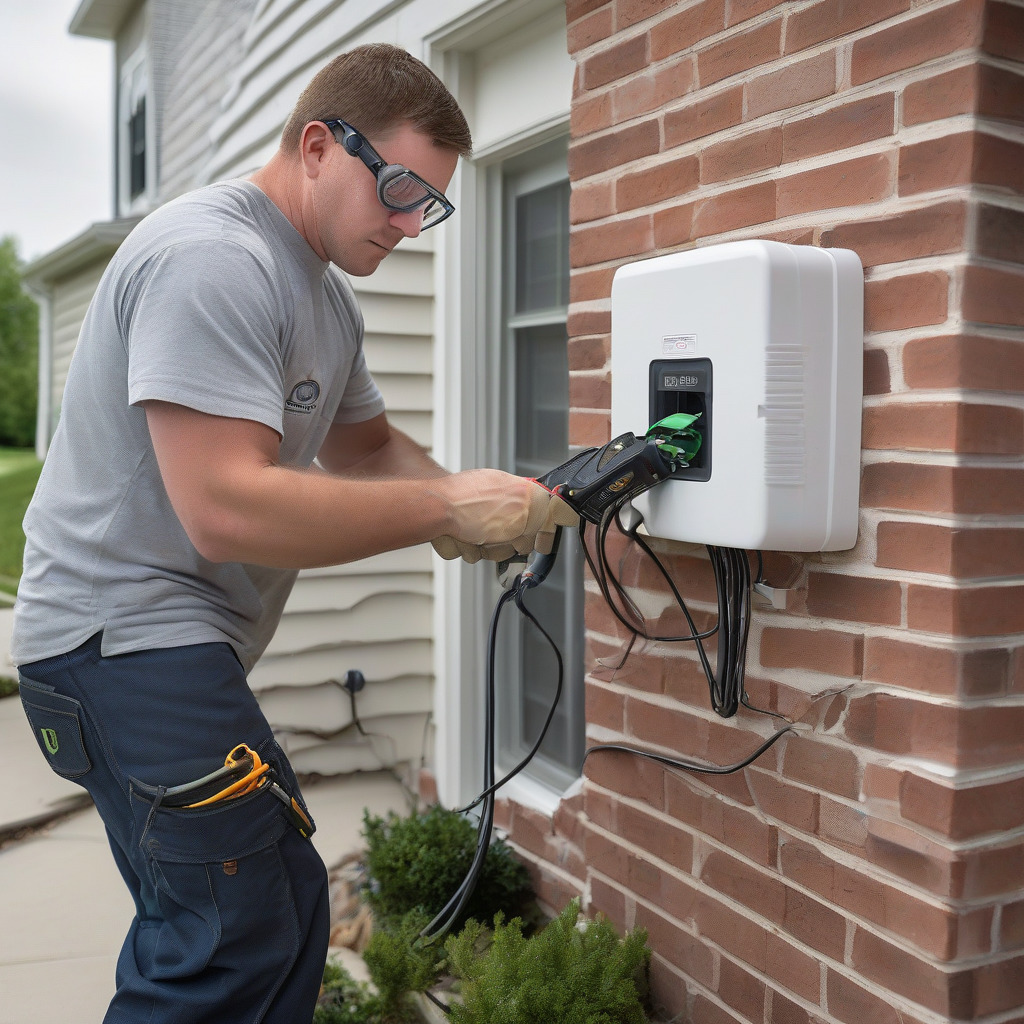
Last fall, a homeowner on the near-Eastside in Irvington — 1948 ranch, attached single-car garage, already-upgraded 200-amp panel — paid $1,340 all in for a Level 2 charger installation. Here’s the breakdown: $185 for a ChargePoint Home Flex purchased directly from ChargePoint, $975 in labor from a licensed Marion County electrical contractor, $85 for the Marion County building permit, and $95 in materials (a new 50-amp breaker, wire, and a surface-mounted conduit cover).
The electrician pulled the permit, scheduled both the rough-in and final inspections, and the whole project ran about three weeks from first call to final sign-off. A two-week wait on the inspection queue ate most of that time.
After applying the AES Indiana residential EV charger rebate ($100 at the time of her application) and the federal 30C tax credit of $360 (30% of $1,200 in equipment and labor costs), her net out-of-pocket came to $880.
That’s the straightforward version: an older home that had already had its panel upgraded, an attached garage, a single-story run. Everything cooperated. Here’s what changes when your situation isn’t that clean.
What Five Indianapolis Electricians Actually Quoted
We contacted eight licensed Marion County electrical contractors in October and November of this year and reached five who quoted on-record. Each received two identical scenarios. Scenario A: a straightforward 50-amp dedicated circuit installation with an adequate 200-amp panel and an attached garage. Scenario B: a longer conduit run to a detached garage — typical of Meridian-Kessler, Broad Ripple, and Butler-Tarkington, where the garage sits at the back of a narrow lot off the alley and the run can stretch 60 to 100 feet from the panel. If you live in one of those neighborhoods, you know exactly which garage layout I mean.
Scenario A — Attached garage, adequate panel, 50-amp circuit
- Burtner Electric (licensed EC, Southside Indianapolis): $850–$950 flat rate, permit included, hardware not included.
- Hoosier Electrical Services (licensed EC, Lawrence): $780 flat rate with a clear caveat that any panel work is a separate change order; permit pulled by contractor; rebate application is homeowner’s responsibility.
- Mid-States Electric (licensed EC, Nora area): $900–$1,100 time-and-materials estimate based on a site visit; permit included; will complete and submit the AES Indiana rebate application on the homeowner’s behalf as part of the job.
- Indiana Electric Pros (licensed EC, Beech Grove): $795 flat rate, permit not included (they quoted the permit separately at the Marion County schedule rate plus $65 in their administrative fee to pull it); hardware bundle available at cost plus 15%.
- Capital City Electric (licensed EC, Fountain Square): $925–$1,050 flat rate for attached garage; permit included; current inspection waits are running 10–18 days for final sign-off.
The spread on Scenario A runs from roughly $780 to $1,100 before hardware and permit, or $865 to $1,265 when the $85 permit is factored in. That’s tighter than most homeowners expect. The variation mostly tracks contractor philosophy. Burtner, Capital City, and Indiana Electric Pros price conservatively and build in margins for site conditions. Hoosier offers the lowest entry point but hands you the permit and rebate logistics.
Scenario B — Detached garage, 60–80 foot conduit run, adequate panel
- Burtner Electric: $1,400–$1,700 flat rate depending on trench vs. surface conduit; permit included.
- Hoosier Electrical Services: $1,200–$1,500 depending on run length, confirmed at site visit; same permit and rebate caveats as above.
- Mid-States Electric: $1,500–$1,900 time-and-materials; whether the run goes underground or surface-mounted along a fence materially changes the final number.
- Indiana Electric Pros: $1,295 for up to 75 feet; each additional 10 feet is $85; permit separate.
- Capital City Electric: $1,600–$1,800 flat rate; noted that older Meridian-Kessler homes with detached garages frequently have subpanel issues in the garage itself that surface at rough-in and can add $200–$400.
The Scenario B spread runs $1,200 to $1,900 before hardware, depending primarily on run distance and conduit method. Underground trenching looks cleaner when it’s done, but every contractor quoted it as an upgrade over the surface-mount base price.
Three of the five contractors — Burtner, Mid-States, and Capital City — quoted flat-rate for straightforward installs. Hoosier and Indiana Electric Pros use time-and-materials or a hybrid. Flat-rate caps your exposure, which is what you want when you can’t predict what’s behind the drywall. Time-and-materials can work if the job is genuinely unusual and you trust the contractor to be straight with you — but if a project has any ambiguity, I’d push for flat-rate or a written not-to-exceed figure. Watching a time-and-materials estimate expand is not fun.
Capital City’s warning about subpanel issues sounds like upselling until you’re standing in front of a 1940s subpanel that is clearly not up to the job. Many Meridian-Kessler homes were built in the 1930s–1950s with undersized garage subpanels that weren’t designed for modern loads. This problem doesn’t surface until the electrician is on-site looking at what’s actually there.
Hardware: What You’re Buying Before Anyone Touches Your Wiring
A quality Level 2 EVSE runs $200 to $900 at retail. The three units that came up most often in our electrician conversations: the ChargePoint Home Flex ($499 list, frequently $450–$480 online), the Enel X JuiceBox 40 ($399 list), and the Tesla Wall Connector ($425 from Tesla, which works with any EV despite the name but integrates best with Teslas). Budget units like the Lectron or Emporia Vue 2 run $200–$250 and are fine if installed correctly. Higher-end units from Wallbox or Grizzl-E run $600–$900.
For this story, hardware selection matters less than installation quality. A mid-range unit on a properly permitted 50-amp circuit will run reliably for 10-plus years. The critical variables are proper breaker sizing, correct wire gauge, and a secure outdoor-rated mount. Spend your decision-making energy there, not on charger brand comparisons.
One practical note: Mid-States and Indiana Electric Pros bundle hardware at cost-plus. When comparing quotes, ask explicitly whether hardware is in or out. It’s an easy detail to miss when you’re juggling three different bids with different line-item formats.
The Panel Question: When Your $1,000 Install Becomes a $3,000 Project
This is where Indianapolis housing stock becomes the biggest variable — and where a lot of homeowners get blindsided.
The near-Eastside, Fountain Square, Irvington, and much of Meridian-Kessler are full of pre-1960 homes originally wired for 60-amp or 100-amp service. A Level 2 charger on a 50-amp dedicated circuit doesn’t technically require more than 100-amp service in isolation. But if you’re already running a central air conditioner, electric dryer, electric range, and water heater on a 100-amp panel, there may not be headroom for a 50-amp breaker. And even if there technically is, every electrician you call will flag that panel as a liability.
The practical threshold: if your home has a 100-amp main panel and was built before 1980, plan for a conversation about whether a panel upgrade is necessary before anyone quotes a final price. Here’s what that adds in the current Indianapolis labor market:
- Panel upgrade to 200-amp service (labor only): $1,500–$2,200, depending on whether AES Indiana requires a new meter socket, whether the main disconnect is in the panel or separate, and how accessible the existing service entrance is.
- Total with panel upgrade, Scenario A: $2,600–$3,400 before hardware and permit; typically $2,900–$3,800 all-in.
- Total with panel upgrade, Scenario B: $3,200–$4,200 before hardware.
Panel upgrades also require AES Indiana to coordinate a service drop change and schedule their own crew for a utility reconnection window. That adds one to three days to the project timeline and is entirely outside your contractor’s control.
Before you sign anything, ask your electrician verbatim: “Does this quote assume my existing panel has adequate capacity with no upgrade needed, and if a panel upgrade is required after your site inspection, will you give me a written change order with a capped cost before any work begins?” If the answer is yes and it later turns out the panel is inadequate, you have a paper trail. If they can’t answer the question clearly, call someone else.
Marion County Permits: Timeline, Fees, and What Triggers a Longer Review
The Marion County building permit for a new 50-amp dedicated circuit with no panel work is classified as a residential electrical permit. The base fee is $85, with a $10 state surcharge, for a $95 total. Contractors typically fold this into project cost. If yours doesn’t, clarify who’s responsible for pulling it before anyone starts work.
For a simple circuit addition on an adequate panel, Marion County Development Services can issue an over-the-counter same-day permit when the application is clean. In practice, contractors filing online through the county’s permitting portal report that straightforward residential electrical permits come back in two to five business days. If the scope includes a panel upgrade, the application triggers a plan review, which pushes the approval timeline to two to three weeks before work can begin.
Once the permit is issued and work is complete, the contractor schedules a rough-in inspection and a final inspection. Right now, final inspections are running 10 to 18 business days out, based on reports from three of the five contractors we spoke with. Capital City Electric’s estimator noted that this lag is relatively stable through winter but historically stretches to three to four weeks during the April-through-June surge, when licensed electricians are being pulled simultaneously toward HVAC changeouts, outdoor panel work, and new construction.
If you want this done by May 1, contract and permit before March 15. A project you start in April may not see a final inspection until late May. That’s not anyone’s fault — it’s just the calendar in this market.
The AES Indiana Rebate: What It Pays, How to Apply, and Whether Funds Remain
AES Indiana — which acquired Indianapolis Power and Light in 2019 and completed the retail rebrand in 2022 — runs a residential EV charger rebate for customers within its service territory. If you’ve been searching “IPL EV charger rebate” and coming up empty, that’s why. The program now lives at aesindiana.com under the rebates section. The IPL name is gone.
Current terms: the residential EV charger rebate pays $100 for the purchase and installation of a qualifying Level 2 EVSE by a licensed electrician. The unit must be a qualifying 240V charger, professionally installed, with documentation of the licensed contractor and the Marion County permit number. Applications are submitted online and require proof of purchase, the installation invoice, and the permit number. The application window is 90 days from installation date. Apply right after the final inspection, not at tax time.
AES Indiana describes this as an ongoing rebate rather than a capped fund, but rebate terms are subject to change with Indiana Utility Regulatory Commission approval. The program was active and accepting applications as of publication. AES Indiana programs have been modified or paused when regulatory filings are updated — don’t sit on the application.
A subset of Marion County addresses — particularly in the far northwest and southwest corners of the county and portions of Lawrence and Beech Grove — fall within Duke Energy Indiana’s service territory. Duke runs its own EV charger rebate, currently $50 for residential customers, through its SmartCharge Indiana program at duke-energy.com. Check your power bill. If it says Duke, that’s your program.
Both programs require professional installation with a valid permit. Skip the permit, lose the rebate. There’s no workaround.
The Federal 30C Tax Credit: Real Math, Not Just a Concept
The Inflation Reduction Act reinstated and extended the 30C Alternative Fuel Vehicle Refueling Property Credit for installations from January 1, 2023, through December 31, 2032. For residential filers, it covers 30% of the combined cost of equipment and installation, capped at $1,000. This is a tax credit — it reduces your federal tax liability dollar for dollar, not just your taxable income.
Applied to actual Indianapolis scenarios:
- Scenario A, simple install: $975 labor + $185 hardware + $95 permit = $1,255 total. 30% = $376 credit.
- Scenario B, detached garage run: $1,500 labor + $185 hardware + $95 permit = $1,780 total. 30% = $534 credit.
- Scenario A plus panel upgrade: $975 + $1,800 panel upgrade + $185 hardware + $95 permit = $3,055 total. 30% = $916, approaching but not quite at the cap.
- Scenario B plus panel upgrade: You’ll almost certainly hit the $1,000 maximum.
The federal 30C credit and the AES Indiana rebate can both be claimed. Here’s a complete cost scenario for a Scenario A homeowner who qualifies for both:
| Line item | Amount |
|---|---|
| Labor | $975 |
| ChargePoint Home Flex hardware | $499 |
| Marion County permit | $95 |
| Gross total | $1,569 |
| Minus AES Indiana rebate | –$100 |
| Minus federal 30C credit (30% of $1,569) | –$471 |
| Net out-of-pocket | $998 |
On a panel-upgrade scenario where gross cost is $3,500: $3,500 minus $100 AES rebate minus $1,000 federal cap equals $2,400 net. Still a significant project, but the credits take a real bite.
One note worth confirming with a tax professional: the IRS guidance on the 30C credit has issued clarifying guidance on which tax year the 30C credit applies to when installation and permit final approval occur in different calendar years. If your install date falls in December, don’t assume. Ask.
A Side-by-Side Cost Table for Indianapolis Scenarios
All figures derived from the electrician quotes and verified sources reported above. Indianapolis-specific ranges, not national averages.
| Scenario | Gross Cost Range | After AES Indiana Rebate | After Federal 30C Credit | Net Out-of-Pocket |
|---|---|---|---|---|
| Simple install, attached garage, adequate panel | $1,150–$1,550 | $1,050–$1,450 | $674–$1,015 | $850–$1,015 |
| Simple install, detached garage, conduit run, adequate panel | $1,580–$2,185 | $1,480–$2,085 | $946–$1,460 | $946–$1,460 |
| Attached garage, adequate panel, plus panel upgrade | $2,900–$3,850 | $2,800–$3,750 | $1,800–$2,750 | $1,800–$2,750 |
| Detached garage, conduit run, plus panel upgrade | $3,400–$4,400 | $3,300–$4,300 | $2,300–$3,300 | $2,300–$3,300 |
Hardware assumed at $450 (mid-range unit). Permit assumed at $95. Labor from five-contractor quote range. Federal 30C capped at $1,000 where applicable. AES Indiana rebate at $100.
Scheduling, Timing, and the Questions to Ask Before You Sign
If you can wait until fall or early winter, do so. October through February is when licensed Indianapolis electricians have the most availability, inspection queues are shortest, and contractors are most likely to honor the lower end of their quoted ranges rather than squeezing your job between larger commercial contracts.
If you’re buying a new EV in April and need the charger immediately, you’re walking into the worst scheduling window of the year. That’s not anyone’s fault, and the work will still get done — just expect delays and don’t expect schedule flexibility from your contractor.
Before signing any contract, ask these questions explicitly:
- Does this quote include the Marion County permit fee? If not, what is the exact cost, and who pulls it?
- Who is responsible for scheduling rough-in and final inspections? (Should be the contractor. If they say you, ask why.)
- Does this quote assume my existing panel has adequate capacity? If a panel upgrade is needed, will you provide a written scope and capped cost before any work begins?
- Is your quote flat-rate or time-and-materials? If time-and-materials, what is the not-to-exceed figure?
- Does your quote assume an attached or detached garage? State your actual configuration explicitly and ask for written confirmation that the quoted run length matches your specific setup.
- Is rebate application my responsibility or yours? Mid-States Electric handles AES Indiana applications for customers; most others don’t. Either way is fine — just know going in.
- Are you a licensed electrical contractor in Indiana with an active Marion County registration? The answer should be immediate and verifiable at the Indiana Professional Licensing Agency site.
Three Mistakes Indianapolis Homeowners Have Made
Skipping the Marion County permit is illegal and voids your AES Indiana rebate, which requires a permit number on the application. It also creates a disclosure problem when you sell — unpermitted electrical work flagged in a home inspection stalls or kills a sale and requires remediation at your expense. The permit process exists to catch undersized wire, a double-tapped breaker, or a breaker in a panel that’s already at capacity. None of the cost scenarios in this piece are tight enough that skipping $95 makes financial sense. It’s not close.
Hiring an unlicensed contractor sidesteps required oversight entirely. Indiana requires a licensed Electrical Contractor to pull a permit for residential electrical work. If someone offers to install your charger for cash without a permit, they’re either unlicensed or knowingly operating outside their license scope — you assume all liability. AES Indiana and Duke Energy Indiana both verify contractor licensure as part of rebate applications, so an unlicensed install also means no rebate and no tax credit. Unlicensed installers often undercut legitimate contractors by 30 percent. You pay for it when you can’t claim the rebate, or when an inspection reveals violations before a home sale.
Buying hardware before confirming panel capacity has cost several Indianapolis homeowners real money. They order a ChargePoint or JuiceBox during an Amazon sale, then get their electrician quote and discover the panel needs upgrading first. The panel upgrade takes weeks to coordinate — including the AES Indiana utility reconnect window — and most online retailers have a 30-day return window that expires while the homeowner is waiting on permit approvals. The impulse is understandable. Holiday sales are real. But buy the charger after your electrician has confirmed panel capacity, or let the contractor source it. The $30 you save buying it yourself on sale is not worth holding non-returnable hardware for six weeks while your project stalls.
More projects like this one — home systems, permits, contractor vetting — are covered in our home and property coverage for Indianapolis residents.
The cheapest legitimate way to install a Level 2 EV charger in Indianapolis: get three quotes from licensed Marion County electrical contractors in October or November, confirm your panel is adequate before signing anything, make sure the permit gets pulled, install a mid-range EVSE, file the AES Indiana rebate within 90 days, and claim the 30C credit on next year’s federal return.
A homeowner with a newer panel and an attached garage can come in under $1,000 net. Done carelessly — wrong contractor, skipped permit, surprise panel upgrade arriving as a change order — the same project costs three times that and still leaves you without a rebate.
What you ask before anyone picks up a screwdriver is almost the whole game.
For more local coverage, explore our Automotive section.