What Indianapolis Drivers Need to Know About Indiana's Minimum Car Insurance Requirements in 2026
The legal floor is 25/50/25. Here's what that number means in real dollars — and why Marion County's uninsured driver problem makes the state minimum a riskier bet than most people carrying it unde…

The legal floor is 25/50/25. Here’s what that number means in real dollars — and why Marion County’s uninsured driver problem makes the state minimum a riskier bet than most people carrying it understand.
Indiana’s minimum car insurance requirements are unchanged heading into 2026. The absence of change is the story. The statutory floor has held steady while hospital bills, body shop invoices, and the share of drivers carrying nothing at all have all moved in the wrong direction. The coverage stayed the same. The world it has to cover didn’t.
If you’re an Indianapolis driver renewing your policy this year and treating the legal minimum as a reasonable baseline, here’s what you should know before you sign.
What Does Indiana Law Actually Require You to Carry?
Indiana’s minimum follows a 25/50/25 structure: $25,000 bodily injury liability per person injured, $50,000 bodily injury liability per accident total, and $25,000 property damage liability per accident.
Read those numbers carefully. The misunderstanding about what they cover tends to be expensive.
This coverage protects other people — the driver and passengers you injure, the vehicle you damage — when you’re at fault. It does not pay for your own medical treatment, your vehicle repairs, or your lost wages. Indiana is a tort state. There’s no mandatory personal injury protection requirement here. Injured drivers file claims against the at-fault party’s coverage, not their own insurer. If you cause the accident, your liability limits are what the other party can collect. If someone else causes it, their limits are what you can collect — assuming they have insurance at all, which is where the real problem starts.
Indiana hasn’t changed these minimums for 2026. Illinois has long required higher limits. Indiana sits roughly at the national legal floor, with limits that haven’t been recalibrated in decades.
The Minimums Didn’t Change — So Why Does That Matter Now?
Because everything those minimums are supposed to cover costs more than it used to. A lot more.
Most vehicles on Indianapolis roads — trucks, SUVs, late-model crossovers — carry market values well above $25,000. If you total the other driver’s vehicle in an at-fault collision, Indiana’s $25,000 property damage minimum may not touch the replacement cost. A 2024 Toyota 4Runner lists around $55,000 new. A used 2019 model runs $35,000 to $40,000 on Indianapolis lots. One collision creates a personal liability gap your policy simply doesn’t cover, and you’re on the hook for the rest.
On the medical side, the numbers are sharper. A serious collision generates costs that can exhaust a $25,000 per-person bodily injury limit in a single hospital stay. An emergency room visit with imaging runs $5,000 to $8,000 before any treatment begins. Orthopedic surgery for a shattered leg runs well past $50,000. Indiana’s minimum limits were calibrated to a cost environment that no longer exists. A single day of hospitalization can consume half the per-person limit. That’s not a hypothetical edge case — that’s a rear-end collision on a Wednesday.
What 25/50/25 Actually Looks Like When You Cause a Serious Accident on I-465
The abstract numbers don’t really land until you put them somewhere real.
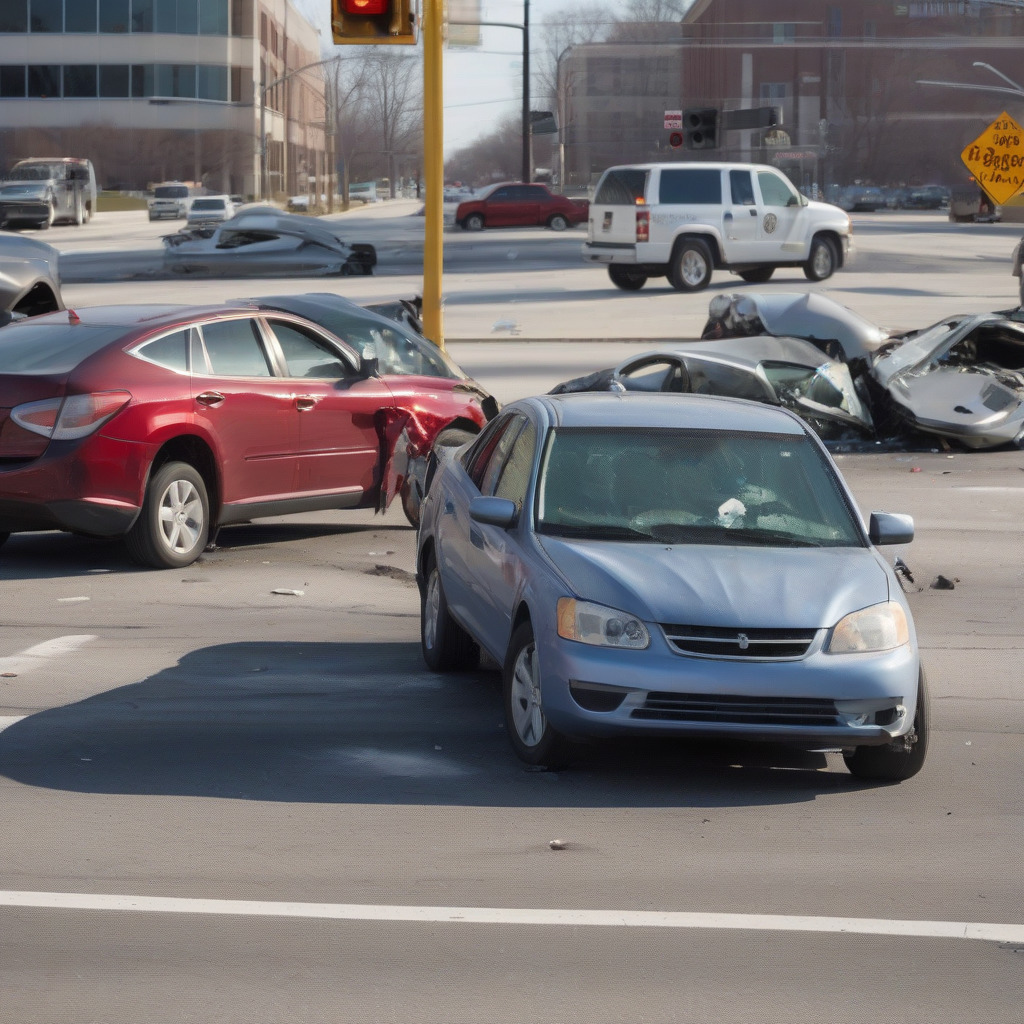
You’re on the I-465 loop near Keystone Avenue on a Tuesday afternoon and cause a rear-end collision at highway speed. The other driver is transported to Community Medical Center with a serious back injury. Her bills over the following months total $80,000. Her passenger breaks his wrist and sustains a concussion; his bills come to $22,000.
Your insurer pays up to $25,000 toward the primary driver’s $80,000. She’s still owed $55,000 your insurance doesn’t cover. Your insurer pays up to $22,000 toward the passenger’s bills — but the $50,000 per-accident cap is the binding constraint here. Total payout for both injured parties cannot exceed $50,000. The $55,000 gap between what the primary driver was owed and what your policy covered is collectible from you personally, through a civil judgment. Your wages, savings, whatever you have.
That scenario isn’t dramatic. It’s what a high-speed rear-end collision on a road that sees thousands of commuters daily actually produces. Indiana’s minimum coverage handles the beginning of a serious claim. Not the rest of it.
How Many Indianapolis Drivers Are Uninsured?
The Insurance Research Council estimates Indiana’s statewide uninsured motorist rate at roughly 14 to 16 percent. Somewhere between one in six and one in seven Indiana drivers is operating without insurance. Urban core rates in cities like Indianapolis typically run above the statewide average, though Marion County-specific figures should be verified with the Indiana Department of Insurance — the state doesn’t publish granular county-level breakdowns.
The practical math is uncomfortable. On any high-volume Marion County corridor — Washington Street, 38th Street, the 465 loop — there’s a real probability that the driver who hits you has no insurance. In Indiana’s tort system, that’s a direct problem. You can’t collect from a policy that doesn’t exist. You can sue the at-fault driver personally, but recovering a civil judgment from someone who couldn’t afford insurance is rarely productive. Ask any Indianapolis attorney who handles these cases. The honest answer you’ll get is: usually not worth pursuing.
What you’re left with, carrying minimum liability-only coverage, is your own vehicle repair, your own medical bills, and your own lost income, entirely out of pocket. Someone who broke the law created the situation and left you no other option. The state minimum was never designed to solve this. It doesn’t.
Indiana Requires Insurers to Offer UM/UIM Coverage — So Why Don’t More Drivers Have It?
Indiana law requires insurers to offer uninsured motorist and underinsured motorist coverage with every policy. Drivers can reject it in writing, and many do. The waiver is simple enough that it often happens at point of sale without the buyer registering what they’re declining. Sign here, initial there, keep moving.
Uninsured motorist coverage steps in when the at-fault driver has no insurance — it replaces the liability policy that should have existed. Underinsured motorist coverage applies when the at-fault driver has insurance but their limits fall short of your actual losses. In the I-465 scenario above, if the other driver carried Indiana minimums and you had $100,000 in UIM coverage, your UIM policy would bridge the gap between their $25,000 and your actual damages, up to your own limits.
In a state where roughly one in six drivers may be uninsured, UM/UIM is the most important add-on available. The cost is modest — typically $15 to $35 a month depending on the carrier and your limits. If you’re not sure whether you declined UM/UIM when you last bought or renewed your policy, pull your declarations page and look. It should appear as a line item. If it’s not there and you didn’t consciously make that choice, call your agent today and find out when it was removed. It’s a five-minute conversation.
What Do Indianapolis Drivers Actually Pay for Minimum Coverage Versus Something Adequate?
For a driver with a clean record in Marion County, minimum liability-only coverage runs roughly $400 to $700 annually depending on the vehicle, zip code, and carrier. Full coverage — collision and comprehensive added to a stronger liability package, commonly 100/300/100 with UM/UIM — runs closer to $1,600 to $2,100 for the same profile. These are recent aggregator estimates; get a current quote from a local agent before treating them as definitive.
The gap is real. About $1,000 to $1,400 per year. I’m not going to pretend that isn’t money. But the out-of-pocket exposure from a single at-fault accident that generates a judgment above your coverage limits can reach tens of thousands of dollars in a single afternoon. The cheaper policy stops being cheaper the moment you use it.
Indianapolis premiums run roughly 10 to 20 percent above the Indiana state average, driven by claim frequency and the density of the 465 corridor. A driver in Bloomington pays less than a driver on Keystone Avenue for the same vehicle, same record, same coverage. That’s geography, not carrier whim. If you moved here from a smaller Indiana market, the premium increase reflects actual local risk. For drivers who recently relocated and are still navigating Indiana vehicle paperwork, [transferring an out-of-state car registration]((/automotive/out-of-state-car-registration-indianapolis/) is a related step worth handling at the same time as your insurance review.
One more number worth keeping in mind: an at-fault accident in Indiana typically raises premiums 30 to 50 percent at renewal. A driver paying $500 for minimum coverage who causes an accident is probably looking at $650 to $750 next year — sometimes higher. The savings from the cheaper policy compound in the wrong direction after you’ve actually needed it.
How Does Indiana’s BMV Actually Enforce the Requirement?
Indiana operates a Continuous Monitoring System through the Bureau of Motor Vehicles, and it’s more automated than most drivers expect. The BMV receives electronic data feeds from insurers and cross-references policy status against registered vehicles. When a policy lapses — missed payment, cancelled policy, switch between carriers without a clean handoff — the system flags the registration and can trigger an automatic suspension notice before you’ve been pulled over or had any interaction with law enforcement.
Indianapolis drivers who let a policy lapse between renewals sometimes discover the suspension when trying to renew their registration online. Not the way you want to find out.
For drivers with prior violations, the enforcement layer gets heavier. A DUI conviction or an at-fault accident while uninsured typically requires an SR-22 filing — a certificate your insurer files with the BMV confirming you’re carrying at least the state minimum. The surcharge alone can exceed $500 annually, which makes the price difference between minimum coverage and adequate coverage far less significant than it looks on the surface. If your license was previously suspended for an insurance lapse and you’ve since reinstated, verify with the BMV that your SR-22 obligation has been satisfied. The BMV’s online portal handles status checks without a branch visit. Calling customer service at 317-232-2050 takes about 15 minutes. Worth doing before assuming everything’s fine.
What to Ask Your Agent Before the Next Renewal
Ask whether your liability limits make sense given what you actually own. If you have a home, retirement savings, or assets above $25,000, a judgment can reach past your policy limits into your personal finances. That’s what liability coverage is for — protecting those assets, not just satisfying a checkbox. Ask your agent to compare your current limits against a 100/300/100 structure and tell you what the premium difference is. Get the actual number.
Ask whether UM/UIM coverage is on your declarations page. If it’s not, find out why. Ask the agent to quote adding it back at limits matching your liability coverage. Given the one-in-six uninsured estimate, this is not a theoretical conversation.
Ask about collision and comprehensive if you’re currently liability-only. If your vehicle is worth more than $15,000 and you couldn’t replace it out of pocket, the argument for carrying collision is straightforward. Most drivers who skip it assume it’s more expensive than it actually is.
Ask about medical payments coverage (MedPay) specifically. Indiana doesn’t require it, but MedPay covers your own medical expenses after a collision regardless of fault — which matters considerably in a tort state where the other driver may be uninsured and the claims process drags on for months. It covers your hospital bills while you’re still fighting someone else’s insurance company for reimbursement.
The independent agency network in Indianapolis — shops that have been writing Marion County policies for years — tends to produce a different conversation than a direct-to-consumer online purchase. Readers who follow our automotive coverage regularly find that local context matters as much as the sticker price on any policy or vehicle. An agent in Beech Grove who has handled 465 corridor claims regularly understands what that commute actually looks like after an accident. A national rate engine doesn’t. The local context is worth more than most people expect when they’re shopping on price alone.
Indiana’s car insurance minimums in 2026 are a legal threshold, not a financial plan. On roads where roughly one in six Indiana vehicles may be uninsured, the gap between the statutory floor and coverage that actually protects you is measurable in specific dollar amounts — and it’s wider now than when those minimums were last set. The decision to carry more doesn’t take a deep insurance education. It takes one direct conversation with an agent who knows this market and is willing to tell you what the cheaper policy leaves uncovered. Most of them will, if you ask.