How the IndyGo Purple Line Is Changing Near-Eastside Home Values
Buyers in 46201 are competing for homes near future BRT stations. In 46218, investors are moving first and asking questions later. And everywhere along Washington Street, the disruption is still ve…

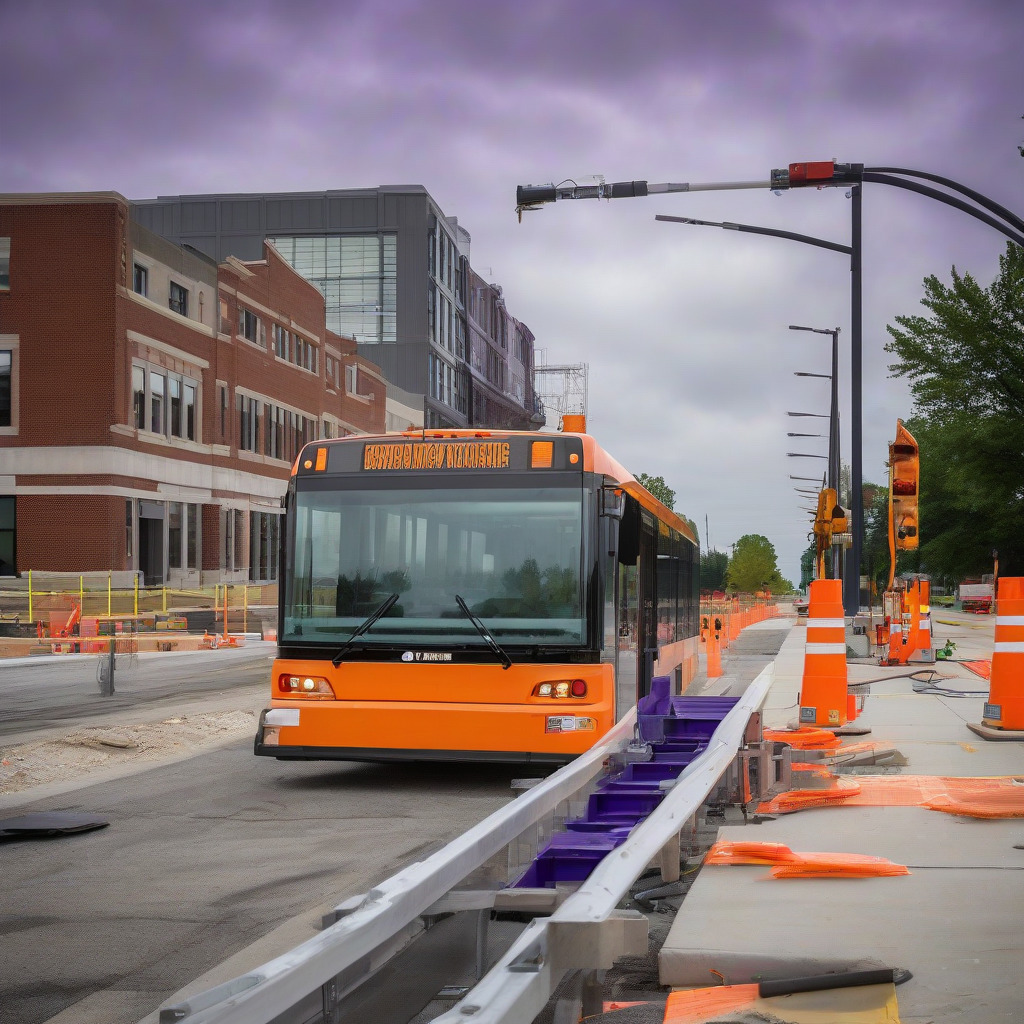
Buyers in 46201 are competing for homes near future BRT stations. In 46218, investors are moving first and asking questions later. And everywhere along Washington Street, the disruption is still very much underway.
On a Thursday afternoon in late June, a buyer toured a two-bedroom bungalow on Beville Avenue, about four blocks south of the future Rural Street BRT station. The asking price was $189,000. The listing had been on the market for six days. There was already an offer on the table.
Outside, half a mile north on Washington Street, orange construction barriers had narrowed the roadway to one lane each direction. A utility crew was working near the station platform footings. The house smelled like fresh paint. The buyer made an offer that evening.
That scene defines the near-eastside market in summer 2026. The IndyGo Purple Line is no longer a planning document. It’s being built on Washington Street right now — but it isn’t finished, the opening date hasn’t been publicly confirmed, and the buyers, investors, and longtime residents in its path are all making consequential decisions in that gap. It’s an uncomfortable place to make a six-figure call.
What the Purple Line Is, and Where Things Stand
The Purple Line is a roughly 16-mile bus rapid transit route running east–west along Washington Street (U.S. Route 40), from downtown Indianapolis through the near-eastside to Cumberland. It was approved as part of the 2016 Marion County Transit Plan, the same income-tax referendum that funded the Red Line on College Avenue.
Construction on the core near-eastside segment is in its late stages as of summer 2026. Station platforms are partially installed at Rural Street, Woodlawn Avenue, Emerson Avenue, and Shadeland. Roadway reconfiguration is ongoing. IndyGo hasn’t confirmed a revenue-service launch date, citing coordination with the City’s Department of Public Works on remaining lane and signal work. The original construction timeline has already slipped from its initial targets.
Every serious buyer, agent, and investor in this market is running the Red Line’s effect backward and applying it here. The Red Line opened in September 2019 along College Avenue and changed property terms across that corridor — both residential and commercial. That’s the available precedent. Whether it translates cleanly to Washington Street is a real question, and anyone who tells you it obviously does is oversimplifying.
Neighborhood by Neighborhood: Where Buyer Interest Is Concentrating
Cottage Home and Holy Cross (46201) are where Purple Line-adjacent buyer demand is sharpest. Both neighborhoods sit immediately south and southeast of the Washington Street corridor, with the Rural Street and Woodlawn stations reachable in a 10-minute walk. They’re also close enough to Fountain Square to capture buyers who were priced out of that market two or three years ago — and there are a lot of those buyers still looking. Our moving & real estate coverage tracks how corridor investment is reshaping buyer decisions across Indianapolis neighborhoods.
“We are getting buyers who say explicitly, ‘I want to be near the Purple Line,’” said one agent who works primarily in the 46201 zip code and asked not to be named ahead of a pending listing. “That didn’t happen in 2022. Now it’s routine.”
Days on market for move-in-ready inventory in Cottage Home have compressed noticeably. Listings under $225,000 that show well are going under contract within a week. The buyer pool is mixed — first-timers, renters converting, relocators from other Midwest cities who specifically cite transit access and walkability. That last group is newer and worth watching. It means the Purple Line story is reaching people before they’ve arrived in Indianapolis, which is a different kind of demand pressure than the city has typically dealt with in this corridor.
Woodruff Place operates on its own logic. The historic district’s formal boulevard system and 19th-century architecture attract buyers who care more about the streetscape than the bus stop. The Purple Line hasn’t changed that profile much. Agents do report more out-of-state inquiries from buyers who discovered Woodruff Place while researching the near-eastside broadly — the BRT interest funneling people into a neighborhood they might not have found otherwise. The historic district overlay limits speculative redevelopment, which depending on who you ask is either a frustration or exactly what the neighborhood needs. Prices are being pulled upward by the broader corridor trend, but Woodruff Place isn’t about to become something unrecognizable.
Irvington already has strong owner-occupant demand, an active Washington Street commercial district, and a neighborhood association that’s been engaged in Purple Line planning since the beginning. The BRT adds a direct, frequent connection to downtown that Irvington didn’t have in any meaningful way before. Agents report buyers who specifically ask about downtown commute access.
“Right now, buyers are taking it on faith,” said one Irvington-area agent. “Once the line is running, that converts from a selling point to a fact.”
That’s worth taking seriously. Buyers pricing on faith and buyers pricing on fact are operating in different markets — and some people purchasing in Irvington right now are paying post-completion prices for pre-completion service. Whether that resolves in their favor depends on whether the Red Line pattern holds. It probably does. Nothing is guaranteed.
Forest Manor and the Meadows (46218) are the starkest case. Investor activity dominates here — LLC purchases, cash transactions, multi-family permit applications. The owner-occupant buyer who is competitive in 46201 hasn’t appeared at scale in 46218. The price data reflects that. This isn’t a failure of the neighborhood; it reflects deeper structural differences in housing stock condition, income levels, and decades of disinvestment. The Purple Line may ultimately benefit Forest Manor residents. Right now, the primary beneficiaries of rising land prices in that zip code are investors, not the people who live there.
The Price Data: Are Values Moving Faster Here Than Elsewhere?
The 46201 picture shows appreciation running ahead of the county. In 46218, the trend is present but uneven.
MIBOR data puts the 46201 median somewhere in the $120,000–$160,000 range in 2020–2021. Current 2025–2026 figures require direct confirmation, but agents and recent transactions suggest the median has moved into the $170,000–$220,000 range — a substantial shift from the zip code’s historical baseline. Marion County’s overall median was in the $235,000–$255,000 range in 2024–2025; buyers should verify current figures through MIBOR or the Indiana Association of REALTORS before treating any single number as settled.
In 46218, the aggregate median masks real variance. Distressed and investor-acquired properties transact far below the middle; renovated stock commands premiums. The median is being pulled up by a relatively small number of higher-quality transactions, not broad-based appreciation. Days on market in 46218 remain elevated compared to 46201, and cash transactions dominate — a reliable indicator that investors, not families, are winning most of the competitive situations. If a cash offer beats yours in 46218, you’re almost certainly not losing to another first-time buyer.
Where a property sits close to a station in a neighborhood with existing buyer demand — walkable amenities, renovated housing stock, sustained interest — the BRT investment clearly contributes to price acceleration. Where those conditions are weaker, the effect is harder to isolate from speculation. In 46218, the Purple Line may be arriving primarily as a land-banking story rather than a community-benefit story. Those are not the same thing.
The Construction Disruption Discount, and What It Means for Timing
Right now, Washington Street is an unpleasant place to be. Lane reductions between downtown and Emerson Avenue have made car access to some properties genuinely difficult. Not impossible — just irritating enough to affect how quickly buyers fall in love with a neighborhood during a showing. Construction noise, equipment staging, the visual chaos of an active major-roadway project — all of it works against listings that sit directly adjacent to the work zone. I’d be skeptical of any buyer who claims it doesn’t register.
That suppression is real. It also has a built-in expiration date.
The Red Line offers a benchmark. During the 2018–2019 College Avenue construction period, road reconfiguration depressed how corridor properties presented to buyers. After the September 2019 opening, that friction disappeared and appreciation followed — at least partly because the construction discount unwound. The disruption proved temporary. The post-completion dynamic proved durable.
As of summer 2026, the most intensive construction zones are near the Rural Street, Woodlawn, and Emerson station areas. If you’re touring a property within two or three blocks of those intersections right now, you’re seeing the corridor at its worst aesthetically. By the logic of the Red Line precedent, you’re also potentially seeing it at the best moment to buy — assuming you can handle living through the last phase of construction. That’s a real ask. It’s also, historically, how some of the better near-eastside deals get made.
Construction friction reduces competition modestly. In a market as tight as near-eastside Indianapolis has been in recent years, that’s not nothing.
Investor Activity: Who Is Buying Ahead of the Line
Marion County Assessor transfer records show elevated LLC and cash-purchase rates in 46201 and 46218, with clustering near the Rural Street, Woodlawn, Emerson, and Shadeland station areas. Multi-family permit applications near Emerson and Shadeland drew attention from community development observers in 2025–2026. Buyers seeking granular confirmation should pull current data directly from the Marion County Assessor’s office and the Indianapolis Division of Planning & Zoning’s public records.
In 46201, investor acquisitions are more likely to involve properties that get rehabbed and listed or rented at market rate — consistent with gentrification-adjacent investment that anticipates future appreciation. In 46218, the pattern skews toward land banking and multi-parcel acquisitions, suggesting investors are positioning for either multi-family development or a future sale once the line is running.
The Opportunity Zone designation, covering parts of both zip codes since 2018, was a significant driver of early investor interest. The federal tax benefit calculus has shifted since then, and investors who entered in 2018–2019 are at varying points in their holding periods. Whether that produces a wave of resales or continued holds will matter for neighborhood stability in 46218 — and nobody has a clean answer to that question yet.
The real issue is whether institutional and semi-institutional buyers are ahead of the curve or have already priced in completion. The Red Line’s post-opening appreciation on College Avenue wasn’t fully anticipated by acquisition prices during construction — which means buyers who understood the pattern captured real gains. It’s reasonable to assume that investors with access to that data have been applying it to the Purple Line corridor for some time. Some of them have been in position since before the 2016 referendum results were certified.
The Zoning and Policy Layer: What City Hall Is and Isn’t Doing
The Department of Metropolitan Development hasn’t adopted dedicated transit-oriented development overlay zoning for Purple Line station areas as of summer 2026. This is the most underreported dimension of the Purple Line story, and arguably the most consequential one.
IndyPlan 2020 supports increased density and mixed-use development along BRT corridors and identifies Purple Line stations as nodes where that development should happen. But a comprehensive plan is not zoning. The distance between stated aspiration and regulatory implementation is where the Purple Line story quietly stalls.
Rezoning applications and variance requests near the Rural Street, Woodlawn, and Emerson station areas are being handled case-by-case through the existing Hearing Examiner process — mostly developers seeking to convert single-family parcels to multi-family, or requesting reduced parking requirements in anticipation of transit access. There is no coordinated station-area planning document of the type that has guided transit-oriented development in peer cities. Indianapolis hasn’t produced one.
The practical consequence: investment near Purple Line stations is happening without any clear city signal about what will or won’t be permitted at scale near each station. In neighborhoods like Forest Manor, the absence of that framework removes the tool community advocates would need to negotiate affordable unit requirements as a condition of upzoning. The Department of Metropolitan Development didn’t respond to a request for comment on the timeline for station-area planning by publication time.
The Equity Question: Displacement Pressure in Martindale-Brightwood and Forest Manor
Near East Area Renewal, which has operated in Martindale-Brightwood and Forest Manor for years, has documented accelerating investor acquisition activity that precedes and runs parallel to Purple Line construction. The pattern is familiar to community development practitioners who’ve watched transit investments elsewhere: outside capital arrives before the infrastructure is complete. Land prices rise on speculation. Longtime residents and renters face displacement pressure before they receive any of the service improvements that were supposed to justify the disruption.
“The people I’m working with in Forest Manor did not vote for the transit plan so that investors from out of state could buy their neighbors’ houses at a discount and flip them,” said one CDC staff member familiar with the corridor who spoke on background. “They voted for it because they wanted reliable bus service. Those are not the same thing, and the market is not treating them like the same thing right now.”
That’s a precise description of a problem Indianapolis doesn’t have a precise policy answer for.
Renter households represent a substantial share of the 46218 population. They have no equity stake in rising property values. They absorb the full cost of rising rents without any upside from asset appreciation. For those households, the Purple Line’s most immediate effect in 2026 isn’t improved mobility — it’s a neighborhood becoming more expensive to live in before the bus has run a single revenue mile. The same market signal that a buyer in Fountain Square reads as opportunity, a renter in Forest Manor reads as a threat. Both readings are accurate. That’s the uncomfortable reality at the center of this story, and the city doesn’t appear to have a serious plan to address it. Renters navigating this pressure should also review their tenant rights in Indianapolis under 2026 law before assuming they have no recourse when lease terms shift.
What Buyers Should Actually Know Before Making a Move
The near-eastside in summer 2026 isn’t a simple buy-now story. It’s also not wait-and-see. It’s a corridor with meaningfully different risk profiles depending on which neighborhood, which station area, and what kind of buyer you are.
For owner-occupants with a genuine interest in living here, 46201 offers the clearest combination of current livability, existing neighborhood infrastructure, and Purple Line upside — specifically Cottage Home, Holy Cross, and the blocks adjacent to the Rural Street and Woodlawn station areas. Prices have moved, but the construction-disruption discount is providing modest relief compared to what these properties will likely command post-opening. If the Red Line pattern holds, that relief is temporary.
Irvington is the lower-urgency option. More expensive at entry than 46201, but more stable and insulated from active construction disruption right now. Buyers who want near-eastside access to a future downtown BRT connection without the current chaos should look here — understanding they’re paying a premium for that comfort.
For buyers considering 46218: the upside case is real, but the timeline is less certain and the housing stock is more variable. If you’re buying to live there long-term and the price works for your budget, that’s a defensible decision. If you’re buying primarily on a Purple Line appreciation thesis, know that the 46218 market carries more uncertainty than boosters tend to acknowledge. BRT benefits in lower-income corridors historically arrive more slowly and less evenly than in higher-income adjacent neighborhoods. That’s not pessimism — it’s the pattern.
A few practical things worth verifying before you make an offer anywhere in this corridor: Check IPS school zone assignments directly. The near-eastside spans multiple attendance zones and boundaries have shifted with ongoing IPS reconfiguration. Don’t assume based on address. Ask your agent for actual walk times to the nearest station platform, not estimates. Pull land sales within two or three blocks over the last 18 months to gauge whether asking prices are already anticipating post-completion values. And understand that IndyGo’s revenue-service launch date is not locked in. If your financial logic depends on a specific opening timeline, build in slack — the Purple Line’s schedule has moved before.
The corridor is already changing. The line isn’t running yet. The buyers, investors, and longtime residents making decisions this summer are doing it under real time pressure, often with incomplete information, in a market where the honest answer to most questions is: it depends, and we’ll know more in 18 months. That doesn’t help anyone writing an offer tonight. But it’s the truth about where this market is right now.
CityDesk Indianapolis covers local business, development, and economic news for Marion County residents. Tips and corrections can be sent to the editorial desk.