What Indianapolis Hail Season Means for Your Car and Your Insurance Claim
Every spring, Indianapolis drivers learn the same hard lesson: a storm that lasted twenty minutes can produce a repair bill that takes twenty days to sort out. If your car was sitting in an open lo…

Every spring, Indianapolis drivers learn the same hard lesson: a storm that lasted twenty minutes can produce a repair bill that takes twenty days to sort out. If your car was sitting in an open lot during a hail event this season—or if you’re trying to get ahead of the next one—this covers the actual decisions you’ll face: what paintless dent repair costs at named local shops, when filing a claim helps you and when it doesn’t, and how to handle a repair market that goes genuinely sideways in the 72 hours after a major storm.
Indianapolis Sits Right on the Edge of Hail Alley
Indianapolis sits on the eastern edge of Hail Alley, the storm corridor that regularly pushes northeast out of Oklahoma and Kansas into central Indiana. Marion County’s peak season runs late April through August. May and June are historically the worst months. The risk isn’t evenly distributed across your day—or across the city.
Where you park determines a lot. The Castleton Square area on the north side is a persistent trouble spot—large surface lots, open geography, the kind of setup that gives storms room to do real damage. Downtown surface lots leave vehicles exposed for full workdays with no shelter option. IMS during Race Month puts cars in open fields and temporary lots through the most active hail weeks on the calendar. If you’ve ever circled the IMS grounds looking for parking on a practice day, you already know how far those cars end up from anything resembling cover.
A storm system moved through the north side in May 2024, hitting the Carmel/Fishers border area with Marion County and producing a weeks-long backlog at area collision shops. That pattern repeats: concentrated geographic hit, immediate pressure on shop capacity, drivers scrambling. Understanding this process before you’re in it is the only real advantage you have. By the time the hail stops, you’re already behind.
What PDR Actually Does, and What It Can’t Fix
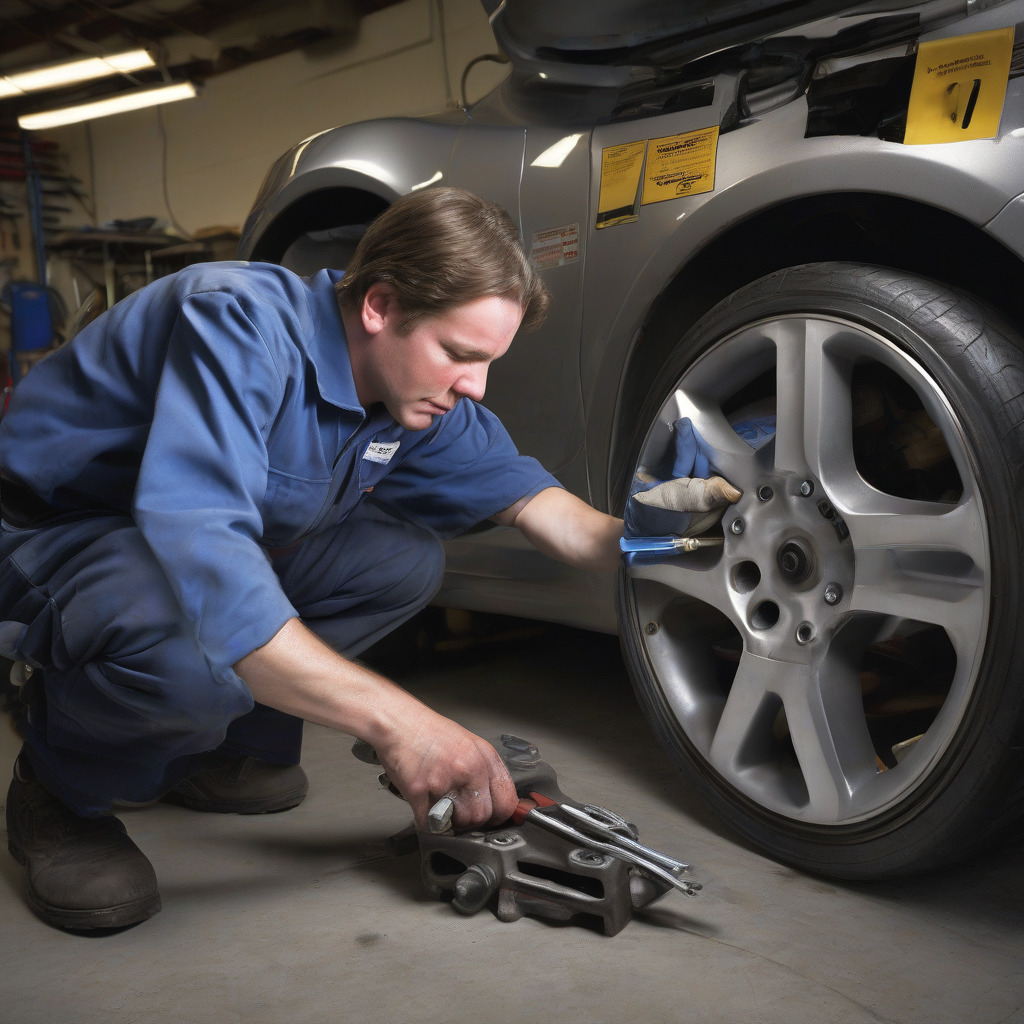
Paintless dent repair is the right method for most hail damage. Technicians remove interior trim panels or tail light assemblies—or run specialized rods through existing access points—to reach the back side of a dented panel and work the metal back to its original contour. No paint. No body filler. No sanding. When it’s done correctly on the right damage, the result is indistinguishable from the factory surface, because the paint is never touched.
That’s also the hard limit of the method. PDR works only when the paint is intact. The moment a hailstone cracks or chips the surface—usually golf-ball-size hail or larger, or smaller stones hitting a panel edge at a bad angle—you’re into conventional bodywork: sanding, filler, primer, repaint. No way around it. Dents on body line creases disqualify a panel. Damage on edges does the same. Metal stretched beyond what can be pushed back without rippling does too.
A good PDR technician will tell you all of this upfront. A shop that promises PDR on everything without looking closely is worth being skeptical about—that’s not cynicism, it’s just experience.
F-150 owners have a specific wrinkle: Ford uses aluminum body panels, and aluminum tears more easily than steel under PDR tools if the technician isn’t set up for it. A lot of shops that do perfectly competent PDR on steel aren’t equipped for aluminum. Before you book an appointment for your F-150, ask explicitly whether the shop has aluminum PDR capability. Don’t assume.
What PDR Actually Costs at Indianapolis Shops
This is the information that’s hardest to find and most useful to have before you’re sitting across from an estimator.
PDR pricing in Indianapolis runs on three different structures. Knowing which one a shop is using changes how you read the number they give you.
Smaller PDR-only operations and traveling contractors often use per-dent pricing. That works fine for isolated damage—a parking lot door ding, a runaway shopping cart. For storm damage it falls apart fast: a moderately hit sedan can have hundreds of individual dents across multiple panels, and per-dent pricing makes a total estimate almost meaningless without a full count in front of you.
Per-panel pricing is cleaner for hail work. The technician assesses each affected panel—hood, roof, trunk lid, each door, fenders—and prices based on panel size, dent count, and severity. This works well when you’re comparing quotes across shops.
Whole-vehicle hail assessment is what you’ll see most often at shops that handle volume storm work. The technician walks the car under a special light board (which reveals dents that ordinary daylight hides), counts and grades the damage, and produces a total estimate. That number should be in reasonable alignment with what your insurer’s adjuster produces. If the two figures are far apart, talk to both parties before you authorize anything.
For current pricing, call shops directly and ask for a quote on a representative vehicle—a mid-size sedan like a Camry or Accord, multiple panels affected, paint intact throughout. Prices shift with damage density, shop overhead, and post-storm demand.
Dent Wizard operates nationally with technicians serving Indianapolis. It works directly with insurers on covered claims and focuses exclusively on PDR, which means faster throughput than a full-service collision shop for straightforward hail work.
Dentmaster Indianapolis is a PDR specialist in the local market. Get a direct quote on your specific damage assessment.
CARSTAR locations in the Indianapolis area are full-service collision shops with integrated PDR capacity. Because their estimators handle both conventional and PDR work, they’re well-positioned to catch damage that sits at the borderline—the panel that has mostly clean dents and one paint chip from the same storm. That matters more than it sounds.
Hendrick Collision, with multiple Indianapolis locations including Shadeland Avenue, handles PDR as part of a broader collision operation and works with multiple insurance carriers on direct-repair programs. Confirm current pricing with each shop before making any repair decisions; rates shift with market conditions, and post-storm demand can move them fast.
The Deductible Math—When Filing a Claim Is the Wrong Move
Indiana drivers carry comprehensive deductibles most commonly at $500 or $1,000, with $250 available at higher premium cost. Hail damage is a comprehensive claim—it’s a weather event, not a collision—so the deductible applies before insurance covers anything.
The easy cases are easy. Repair estimate of $3,200, deductible of $500: file the claim, collect $2,700, move on. Estimate of $800, deductible of $1,000: insurance pays nothing, you pay out of pocket, skip the paperwork. No real decision there.
The middle is where it gets murky. Your deductible is $1,000, your PDR estimate is $1,200. Filing gets you $200. The real question is whether that claim raises your renewal premium—and the answer depends on your carrier in ways that aren’t always predictable ahead of time. Comprehensive claims for weather events are not-at-fault, and many carriers treat them more favorably than collision claims. Some carriers still factor comprehensive claim frequency into renewal pricing. I’ve heard both stories from drivers who were surprised in opposite directions.
Before you file, call your agent and ask directly: will this claim affect my renewal premium, and by how much? Get the answer in writing if you can. Erie Insurance and State Farm both have significant market presence in central Indiana; so does GEICO. Ask your specific carrier. “It depends” is a real answer here, and the only way past it is to put a specific scenario in front of your specific agent.
DRP Shops—What the Referral Network Actually Means for Your Repair
When you file a hail claim and your insurer recommends a shop, that’s almost always a direct repair program referral. Here’s how DRP works: shops agree to honor the insurer’s labor rates and parts sourcing preferences in exchange for a steady stream of referred claims work. The insurer gets volume discounts. The shop gets guaranteed business. It’s a straightforward commercial arrangement, and you should understand it as such before assuming the referral is purely a quality endorsement.
Major DRP networks with Indianapolis-area presence include State Farm Select Service, GEICO Auto Repair Xpress, Allstate Good Hands, and Erie’s preferred shop network. Hendrick Collision and several CARSTAR locations participate in one or more of these. Specific participation changes, so confirm with your insurer and the shop directly.
For PDR work, the DRP tradeoff has real teeth. PDR is almost entirely a labor product—there are no parts to substitute or mark up. When the labor rate is compressed under a DRP agreement, the time a technician spends on your car gets compressed too. On a heavily dented hood, that can be the difference between a complete repair and one where the shallower dents were left because the job was priced to a ceiling. That said, many DRP shops do excellent work, and the insurer’s workmanship guarantee is real consumer protection if something goes wrong after pickup.
What most Indianapolis drivers don’t know: Indiana does not require you to use your insurer’s preferred shop. Your insurer may tell you that going outside the DRP network complicates the process—and it does, in the sense that you’ll likely need to get your own estimate and submit it. But they cannot legally force you to use their preferred vendor. If you want a PDR specialist instead of a full-service collision shop, you can go there. Verify this with the Indiana Department of Insurance or a licensed Indiana agent if you run into pushback.
Post-Storm Reality—Which Shops Can Actually Take Your Car
In the 48 hours after a major hail event, the practical question isn’t which shop is best. It’s which shop has an opening.
Full-service collision shops in Indianapolis—CARSTAR, Hendrick, and comparable operations—typically fill their schedules within three days of a significant storm. By the end of that first week, a five- or six-week wait is common. This isn’t a failure of capacity. A storm hits a section of the city, thousands of cars need repair, and the shops serving that area stack up fast. Plan for it.
PDR specialists move faster, for two reasons. They’re not juggling collision work, conventional refinishing, and PDR simultaneously—PDR-only shops process more cars per week because each job is quicker. And they don’t face the parts-ordering delays that stretch full-service timelines.
If your damage is paint-intact—dents without cracked or chipped paint—call PDR specialists first. Dent Wizard and Dentmaster Indianapolis should be your first two calls. Get on their list before you even schedule an adjuster visit, if you’ve already decided to file a claim. At many PDR shops, the assessment and the repair appointment are combined, which saves you a trip.
If your damage clearly involves broken paint on multiple panels, you need a full-service shop. For context on the wider Indianapolis repair landscape, our automotive coverage includes shop-by-shop breakdowns updated through the current season. Call anyway. Get on the list. Some shops maintain a storm-volume wait list separate from their booked schedule—ask specifically, because not every shop mentions it. Don’t wait two weeks to start calling because you’re waiting to hear from your insurer. Insurance timelines and shop scheduling timelines run in parallel. Get your name on a list now.
Storm-Chasing Contractors—How to Recognize Them and What Indiana Law Does and Doesn’t Do
Within two or three days of a major Indianapolis hail event, traveling PDR contractors move into the market to work storm-season volume. You’ll find them set up in parking lots at Castleton, Keystone at the Crossing, and Greenwood Park Mall in Johnson County. Some approach drivers directly. The pitch is fast turnaround, low price, and an offer to handle your insurance paperwork—which sounds appealing when local shops are already booking five weeks out.
Some of these contractors are skilled technicians doing legitimate work. Some are not, and the Indiana Attorney General’s office has issued consumer alerts about post-storm auto repair fraud specifically: contractors who take deposits and disappear, perform inadequate repairs, or inflate claims submitted to insurers. You can file a complaint with the AG’s Consumer Protection Division through the Indiana Attorney General’s website. That’s not a formality—it’s how the state tracks patterns across storm seasons.
A legitimate shop, traveling or local, looks like this: a verifiable permanent address, a phone number that reaches a real local office, reviews tied to a business listing that predates this storm season, a written estimate before any work begins, a written warranty, and no request for your insurance payment before the repair is done. If a contractor skips any of those, walk away.
One thing traveling contractors are actually useful for: faster assessments than backlogged local shops can offer. Get the assessment. Take that information to a local shop you’ve verified. What you should not do is sign a work authorization with someone you can’t confirm before checking their references and their physical location. If you have a bad experience, report it to the Indiana AG. No exceptions.
Before You Drop Off the Car
Most drivers skip the documentation step. It’s understandable—nobody wants to spend an hour crawling around a dented car with a flashlight after a stressful week. Do it anyway.
Before the car leaves your driveway, photograph every panel in daylight. Work around the full vehicle—front, both sides, rear, roof, hood, and trunk lid at multiple angles. Hold a flashlight low and parallel to the panel surface to catch shallow dents that flat daylight misses. These photos establish pre-repair condition and protect you from being billed for damage that predates the storm or happens during the repair itself.
Catalog any existing damage while you’re at it: old scratches, prior dents, paint chips. Note them on the estimate form explicitly before you sign. If the shop’s estimate includes that door ding you’ve had since 2021, you want to know—and so does your insurer.
Before signing a work authorization, ask these questions: Is this repair PDR, conventional bodywork, or a mix? Which panels are getting which treatment? If parts are being replaced, are they OEM or aftermarket? What does the written warranty cover, and for how long? What’s in the estimate, and what could change the final price?
A shop confident in its work puts the warranty in writing without hesitation. One that hedges on that question is telling you something worth hearing.
Reporter verification priorities before publication: On-record PDR pricing confirmed with Dent Wizard, Dentmaster Indianapolis, CARSTAR, and Hendrick Collision representatives; DRP participation for State Farm, GEICO, and Erie verified with carrier and shop contacts; Indiana DOI or licensed agent on record regarding comprehensive claim rate impact and consumer shop-choice rights under Indiana insurance code; Indiana AG consumer alert link confirmed active; NOAA Storm Events Database entries for Marion County May 2024 event confirmed, including geographic scope and hail size.