How Indianapolis Food Halls Compare and Which One Is Worth Your Time
The Garage at Bottleworks, AMP at 16 Tech, and Indianapolis City Market, evaluated on vendor stability, parking costs, real meal prices, and who's actually in the seats on a Tuesday.

The Garage at Bottleworks, AMP at 16 Tech, and Indianapolis City Market, evaluated on vendor stability, parking costs, real meal prices, and who’s actually in the seats on a Tuesday.
Indianapolis has three food hall options worth serious consideration right now, and they are not equally worth your time. This guide covers all three with the specifics that roundup pieces typically skip: what a lunch actually costs after you pay to park, which vendor rosters have thinned out, and whether any of these halls generates enough foot traffic to feel alive on a Wednesday at noon.
The short answer, for readers who want it up front: The Garage at Bottleworks has the strongest vendor mix and the best atmosphere. AMP at 16 Tech has real potential but lives and dies on weekday campus traffic. Indianapolis City Market isn’t technically a food hall, but it competes for the same lunch dollar and still wins on value and history for anyone working near the government district. None of the three justifies a dedicated cross-town drive from the suburbs on a slow weekday unless you have a specific vendor in mind.
The State of the Room in 2026
Indianapolis entered 2026 in a familiar holding pattern: a handful of operating food hall concepts, a couple of announced projects still in development purgatory, and the ongoing challenge of convincing suburban diners that a food hall lunch is worth the coordination. This city has been in some version of that conversation for years.
The Garage at Bottleworks operates inside the adaptive reuse of the former Coca-Cola bottling plant on Massachusetts Avenue, developed by Hendricks Commercial Properties. It’s had several years to shake out its vendor roster and find its audience. AMP at 16 Tech sits inside the 16 Tech innovation district campus northwest of downtown, targeting the tech and biotech workers filling that corridor. City Market has been operating in some form for well over a century and needs no introduction to anyone who’s worked downtown longer than a year.
No major new food hall concept opened in Indianapolis between fall 2025 and the time this piece was reported. A concept that had been circulating in development conversations for Fountain Square did not materialize on any confirmed timeline — which is getting to be a recurring story with that neighborhood and big announcements. The near-eastside and Broad Ripple remain without a dedicated food hall as of mid-2026.
The Venues
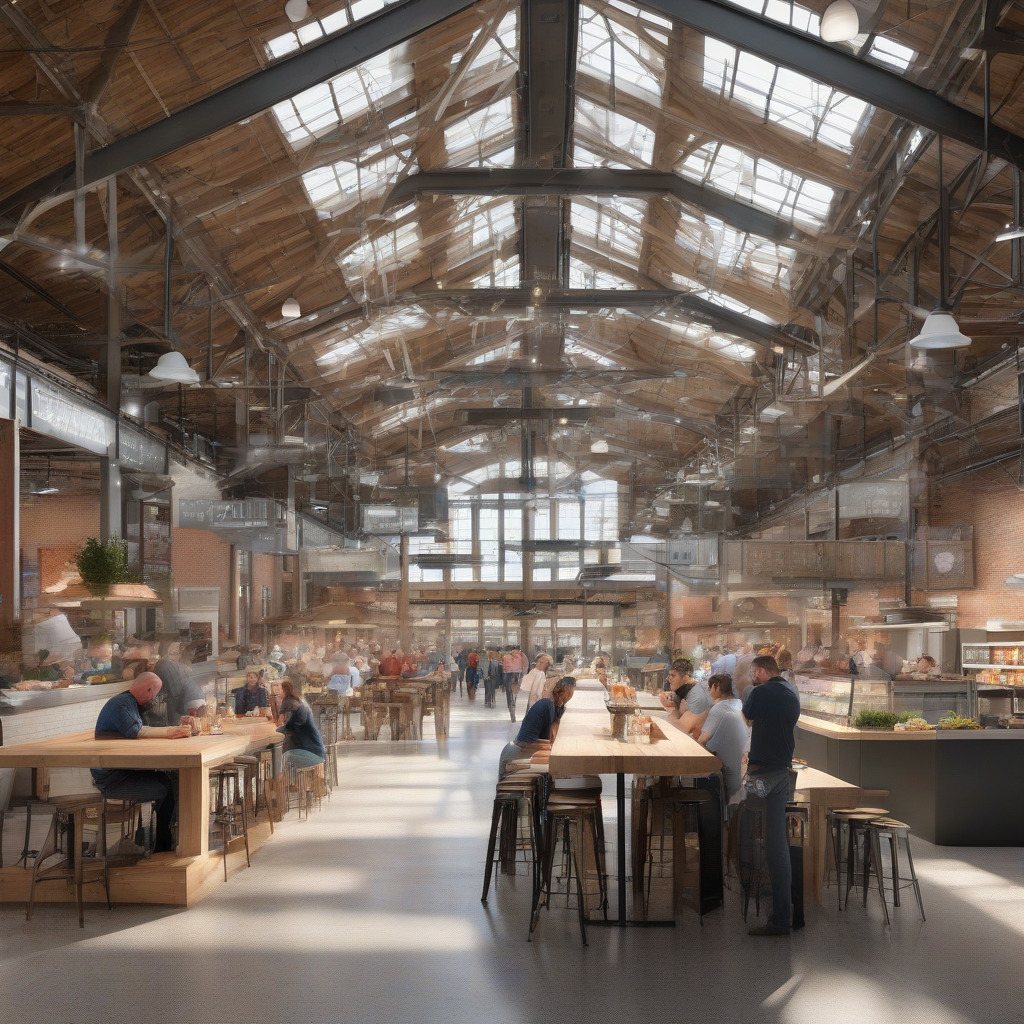
The Garage at Bottleworks sits at 850 Massachusetts Avenue in the Mass Ave arts district, walkable to Bottleworks Hotel and the broader corridor. High ceilings, terrazzo floors, original beams — the space feels like somewhere rather than nowhere. Hours vary by vendor. The Bottleworks District has a dedicated parking garage; check current rates and any validation policies before you go. Metered street parking on Mass Ave is also an option for shorter visits.
AMP at 16 Tech operates inside the 16 Tech innovation campus northwest of downtown near IUPUI. It’s a purpose-built, modern space — functional and clean-lined, which is a diplomatic way of saying it does exactly what it was designed to do and not much more. Campus parking is on the 16 Tech grounds. Hours are structured around weekday campus traffic, and weekend availability is limited. Check current hours and parking access before making a trip.
Indianapolis City Market occupies a red-brick Romanesque building from the 1880s at 222 E. Market Street, a short walk from the City-County Building and the courthouse. It mixes permanent indoor vendors with rotating Shed stalls and operates primarily as a weekday daytime operation; Saturday hours shift seasonally around the outdoor farmers market. Metered street parking on Market Street is available, and the City Market Garage sits adjacent. The building has genuine historic bones. The vendor quality is another matter — variable year over year, sometimes lovably so, sometimes not.
Vendor Rosters: What’s Actually There
Food hall vendor turnover is high, and the single biggest weakness in competing roundup content is stale stall lists. A vendor that opened with fanfare eighteen months ago may be gone. The venue website often hasn’t caught up. What follows reflects conditions as of this reporting. Verify current rosters directly before making a trip based on a specific stall.
The Garage at Bottleworks has multiple active stalls covering a range of cuisines and formats, anchored by a central bar serving beer and cocktails. The hall has absorbed turnover since opening, but replacement has kept pace with departures. Not every vendor operates every day or opens at the same time as the hall itself. Show up at 11 a.m. on a weekday and several stalls may not be serving yet. Check the Bottleworks website or call ahead.
AMP at 16 Tech works with a smaller vendor footprint that reflects its campus-service mission. The mix is oriented toward quick-service formats suited to a weekday lunch window — which is also its limitation. It’s not diverse enough to sustain repeat visits across a full work week without the menu feeling repetitive. There’s been turnover on the innovation district vendor roster. The remaining lineup is solid, but it’s not a destination on its own merits.
Indianapolis City Market is the most complicated to assess because it blends permanent indoor vendors with the outdoor Shed market and a seasonal farmers market program. The quality range across stalls is genuinely wide. Some vendors are excellent. Some feel like they’ve held their leases by inertia rather than merit. The Shed comes alive on farmers market days — Wednesdays and Saturdays — with a pop-up energy that’s different from the rest of the week. The honest read: the building deserves its reputation as a civic institution, and several individual vendors are genuinely good, but City Market as a curated food experience is less coherent than either of the purpose-built alternatives.
What a Meal Actually Costs
Getting a real number requires accounting for parking, because that math changes the calculus for a suburban visitor more than most roundups bother to acknowledge.
At The Garage at Bottleworks, expect to spend roughly $16 to $24 per person for a full lunch with a non-alcoholic drink, before tax. That’s not cheap for a weekday casual meal. Whether the Bottleworks garage offers any validation with purchase is worth checking before you arrive — the difference between free validation and $10 in parking changes the math on a solo lunch errand.
AMP at 16 Tech lands somewhat lower, consistent with a campus-service model, and campus parking generally doesn’t carry the same cost structure as downtown metered lots, which improves the overall value. Confirm current figures on-site.
Indianapolis City Market is broadly comparable to AMP on food prices, with metered street parking on Market Street available for shorter visits and the adjacent garage charging standard downtown rates.
Bottleworks vs. AMP
For a reader choosing between the two purpose-built food halls, here’s what actually matters.
Bottleworks wins on atmosphere. The former Coca-Cola bottling plant provides exposed original architecture, high ceilings, and designed lighting. The space feels invested in. AMP at 16 Tech is clean and well-executed for a campus amenity, but it was designed to feed innovation workers efficiently, not to create an experience anyone would drive across town for. You can feel that difference the moment you walk in — a room someone cared about versus a room someone budgeted for.
On accessibility, Bottleworks sits directly on the Mass Ave corridor with the Cultural Trail running adjacent and the Red Line a reasonable walk away on the College/Meridian spine. AMP is reachable by IndyGo, but it’s not a casual transit trip from most neighborhoods, and the surrounding streetscape is campus infrastructure rather than a walkable retail district. Nobody passes through 16 Tech incidentally. You go there on purpose.
The weekday-versus-weekend divide is the sharpest difference. Bottleworks pulls organic foot traffic from the hotel, the Mass Ave corridor, and event traffic from Gainbridge Fieldhouse. On a Saturday afternoon it’s populated and alive without requiring any particular occasion. AMP runs on weekday campus traffic, its hours reflect that, and it has essentially no weekend identity for walk-in visitors. That’s not a flaw exactly — it serves its stated audience well — but showing up on a Saturday to find the building closed or nearly empty is a rough discovery after you’ve driven across town.
Bottleworks also has a central bar with full service during hall hours. AMP’s beverage situation is oriented toward the daytime work-lunch crowd.
For a weekday lunch if you’re already near the near-westside, AMP wins on price and parking ease. For an evening, a weekend, a first-impression tour of the city’s food scene, or any situation where the experience itself matters, Bottleworks is the clear answer. Readers interested in the broader Indianapolis dining and hospitality landscape will find more context in our food & hospitality coverage.
Where City Market Fits In
Indianapolis City Market isn’t a food hall in the branded, post-2015 sense. It’s a municipal market house that predates the food hall concept by generations and competes directly for the lunch dollar of anyone working or visiting the government district. Comparing it to Bottleworks almost feels unfair in both directions — City Market is doing something older and messier, and that’s part of what makes it worth defending.
The Wednesday and Saturday farmers market in the Shed activates the outdoor space with local produce, specialty food vendors, and street-market energy that’s genuinely different from anything Bottleworks or AMP offers. If your visit lands on a farmers market day, City Market delivers something the purpose-built halls can’t touch. The building carries civic history that makes eating there feel different from eating in an adaptive industrial conversion. Some people value that. I do, even when the food is uneven — and it is sometimes uneven.
What City Market lacks is consistent curation. The vendor mix reflects decades of accumulated lease arrangements rather than any unified vision, and the quality range is wide. The building can feel underpopulated on a slow Friday afternoon after the government-worker lunch crowd clears out. If you’re downtown on a Wednesday or Saturday when the market is running, it makes sense. If you work nearby and want a reliable lunch without friction, it works. It is not, however, worth driving in from the northside for.
The Verdict by Use Case
Weekday office lunch. AMP works for anyone already in the 16 Tech or IUPUI corridor. For everyone else downtown, City Market wins on proximity and value. Bottleworks is a reasonable weekday lunch if you’re already on Mass Ave, but it’s the highest-friction option of the three for a solo midday errand.
Weekend outing or date night. Bottleworks, without much competition. It’s the only one with weekend hours that support a leisurely visit, a bar worth sitting at, and enough activity to make an evening of it. If you need to show someone Indianapolis food culture — a visitor from out of town, a client dinner that should feel local — this is where you take them.
Visitor with one meal slot. Bottleworks again. Multiple active vendors, a drink, a genuine piece of the city’s built environment and food culture in one stop. City Market deserves a mention if the visitor is specifically interested in civic history, but the food execution at Bottleworks is more reliably impressive.
Cross-town drive from the suburbs. Probably not, for any of the three, as a primary purpose. From Broad Ripple, Bottleworks earns the Cultural Trail ride if you’re pairing it with something else on Mass Ave. From farther out, the drive-and-park math requires you to really want what Bottleworks offers. There are enough strong standalone restaurants on Mass Ave that you might skip the food hall format entirely on a dedicated trip. AMP and City Market are not destination experiences for suburban visitors; they serve their respective weekday communities well.
What Indianapolis Is Still Missing
For a metro of 880,000 people, Indianapolis’s food hall options are functional but incomplete. Columbus has North Market, which has operated as a civic food institution since 1876, and Budd Dairy Food Hall, which demonstrated that food halls can anchor neighborhood nightlife rather than just weekday lunch service. Louisville and Nashville both have food-and-entertainment corridors operating at a scale that illustrates what a convention-city market can actually support.
Indianapolis hasn’t built a food hall with evening and weekend neighborhood-anchoring power outside of the Bottleworks zone. Bottleworks is doing a lot of heavy lifting to cover for that gap.
Fountain Square is the obvious candidate — existing arts and entertainment identity, walkable blocks, younger demographic. The concept has circulated in development conversations for years. Nothing is on a confirmed timeline as of this reporting. For a closer look at what’s actually trading in that neighborhood, recent Fountain Square real estate activity illustrates how the development pipeline is shaping up. Broad Ripple’s village corridor, which has hollowed out from its late-2000s peak, is another reasonable location, though land costs and access constraints complicate the math. Whether a well-conceived market-style food hall materializes in either neighborhood will say something real about how seriously this city is willing to invest in its most walkable districts — and how long it’s prepared to let them wait.
A Note on Currency
Vendor lists change with lease cycles, seasonal shifts, and business closures — sometimes quickly, and sometimes without public announcement. Before making a trip based on a specific vendor, verify current tenant lists and hours directly with each venue. The Garage at Bottleworks and AMP at 16 Tech both maintain social media accounts that tend to reflect vendor updates faster than their websites do. Indianapolis City Market posts weekly Shed and farmers market schedules on its website. Parking rates at the Bottleworks garage and the City Market Garage are subject to change; confirm before visiting. CityDesk Indianapolis will update this piece at the next major vendor roster change at any of the three locations.