What Is a French Drain and Does Your Indianapolis Yard Actually Need One
Flat lots, heavy clay soil, and wet springs make Marion County a reliably active market for drainage contractors. Here's how to tell if you actually need one — and what it will cost.

Flat lots, heavy clay soil, and wet springs make Marion County a reliably active market for drainage contractors. Here’s how to tell if you actually need one — and what it will cost.
Standing water after a rain is one of the most common complaints among Indianapolis homeowners. It’s also one of the most reliably monetized by drainage contractors. That’s not a knock on contractors — drainage problems are real, and in Marion County they’re structurally baked into the geography. But “french drain” has become a near-universal answer to a problem that sometimes has a much cheaper solution. Before you sign anything, understand what a french drain actually does, what the soil conditions here mean for how long it lasts, and whether your yard needs one at all.
Why Indianapolis Yards Flood in the First Place
Marion County sits on terrain scraped flat by glaciers and farmed for generations before it was subdivided. Residential lots across Warren Township, Pike Township, Lawrence, and Beech Grove — areas developed heavily in the postwar decades and again through the 1970s and ’90s — often have surface grades of less than one to two percent. That’s the minimum slope water needs to move. Below that threshold, rain doesn’t run off. It sits.
This isn’t homeowner neglect. Geography did this. The former agricultural flatland those subdivisions were built on had drainage tile networks designed for field crops, not residential lots with impervious driveways, compacted lawns, and downspouts discharging at the foundation. When those old tile systems were disrupted by development or simply aged out, the natural outlets disappeared.
The Marion County spring makes it all visible. March through May, the city averages enough rainfall to expose every drainage weakness on a property — Indianapolis receives roughly 42 inches of precipitation annually, with spring months doing the heaviest lifting. Soils are saturated and haven’t had time to dry between rain events. That’s when most homeowners start searching for answers, and when drainage contractors are fielding calls faster than they can schedule site visits. If you’ve tried to get a drainage contractor on the phone in April, you already know what that backlog feels like.
What a French Drain Actually Does
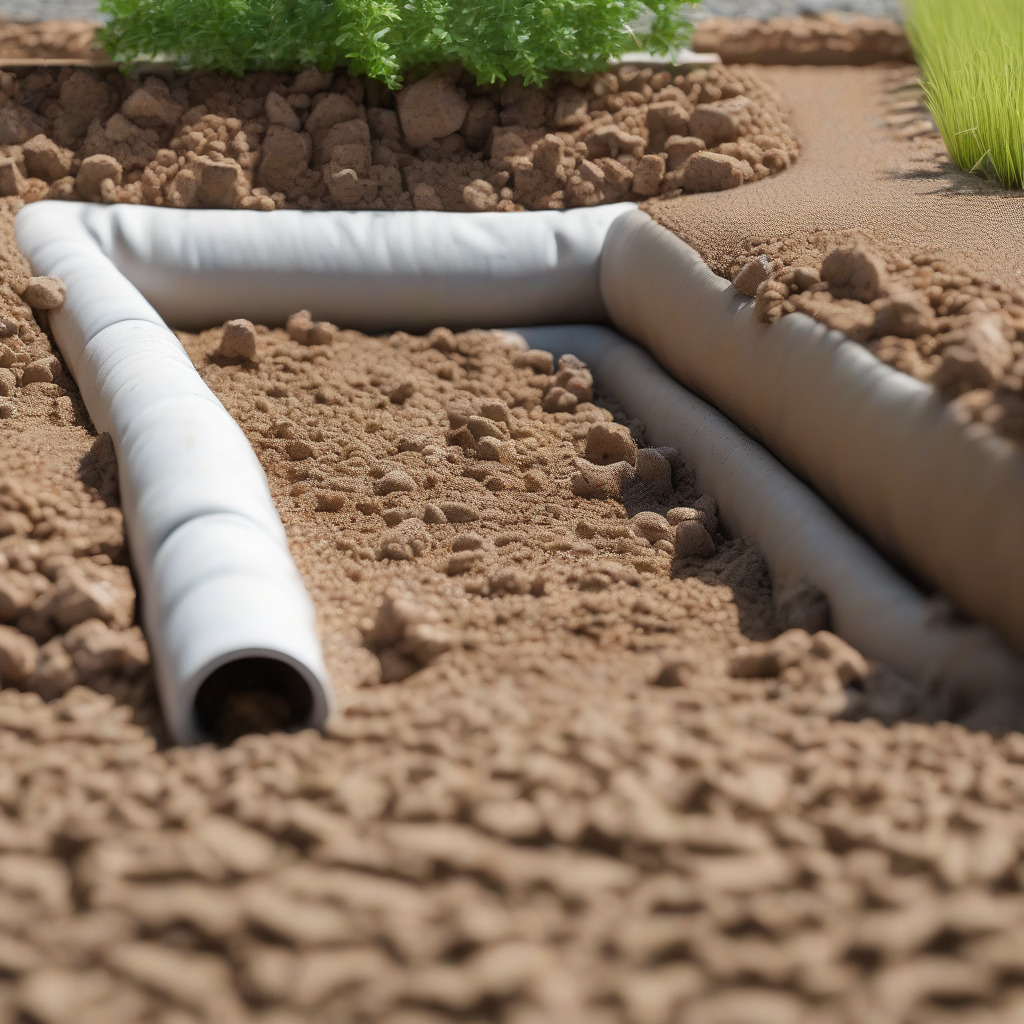
A french drain is simple: a gravel-filled trench containing a perforated pipe. It intercepts water — either moving through the soil or pooling at the surface — and redirects it to a lower outlet point. That outlet might be a street curb opening, a daylight point at the edge of a property, or a dry well if no lower outlet exists.
The physics are straightforward. Water follows the path of least resistance. A gravel-filled trench is dramatically easier for water to move through than surrounding clay, so water migrates toward the trench, enters the perforated pipe, and flows by gravity to wherever the pipe exits. In a yard where water pools because the soil absorbs it too slowly, a french drain gives that water a faster path out.
What a french drain does not do matters equally. It doesn’t fix the source of water intrusion. If your gutters are dumping water against your foundation, extending the downspouts is a $50 fix, not a $6,000 one. It doesn’t solve a genuinely high water table — properties near Eagle Creek, Fall Creek, or Pleasant Run can have seasonal water tables that sit just below the surface, and a french drain at typical installation depths won’t intercept that reliably. And it doesn’t substitute for proper grading. Installing subsurface drainage on a lot that needs topsoil and a regraded swale addresses a symptom rather than the cause.
A contractor who jumps straight to a french drain proposal without asking where your water is coming from is skipping a diagnostic step you should notice.
Marion County Clay — Why Soil Type Changes Everything
Most national content about french drains treats soil as an afterthought. In Indianapolis, it’s the central issue.
Marion County’s dominant residential soil types — the Brookston and Crosby series clay loam — have hydraulic conductivity that often falls below 0.2 inches per hour. Water moves through the native soil at a crawl. A rain event that a city with sandy or loamy soil would drain in a few hours can leave Marion County yards standing wet for two or three days. That’s just what Brookston and Crosby clay does, and no amount of lawn aeration is going to fundamentally change it.
That slow conductivity is exactly why french drains get pitched here so frequently — and honestly, the pitch isn’t wrong. The gravel pathway genuinely outperforms the surrounding soil. But clay creates a second problem that contractors should be pressed on directly: clay particles are fine enough to migrate through standard filter fabric over time. The geotextile sock wrapping the gravel trench is supposed to keep soil out of the pipe. Cheaper fabric or the wrong specification allows fine particles to migrate in, gradually silting up the pipe. In sandy soil, a french drain might function well for 20 to 30 years. In Marion County clay with inadequate filter fabric, a system can start losing effectiveness in under a decade. This comes up repeatedly when homeowners call contractors to troubleshoot a drain that “stopped working.” It’s fixable — but it costs real money to excavate and replace fabric that should have been specified correctly the first time.
There’s a third local factor: freeze-thaw cycles. Indianapolis averages roughly 17 to 20 per year. Each cycle can slightly heave the pipe, and over years that creates subtle dips where water and sediment collect rather than drain. A properly installed system accounts for this with adequate slope and clean-out access points. A system installed with marginal slope in clay, without clean-outs, may require full excavation to service rather than a simple flush. That’s the difference between a $200 maintenance call and a $4,000 problem.
When you’re getting quotes, ask each contractor what geotextile specification they use in clay soil. If they can’t answer the question, keep calling.
Do You Actually Need a French Drain, or Just Better Grading?
Stand at the edge of your yard during or just after a rain and watch where the water is coming from. Is water moving across the surface from a neighbor’s lot, running off a driveway, or pouring out of a downspout? That’s a surface water problem — often a grading and diversion problem that a few hundred dollars of topsoil can handle. Is it welling up from below, or appearing in low spots with no obvious inflow from above? That points more clearly toward a soil drainage problem where subsurface work makes sense.
How long water stands matters too. Standing water for two to four hours after a heavy rain on flat ground in Marion County is normal. Genuinely normal, not a sign something is broken. Water standing 48 hours or longer, repeatedly, in the same low spots: that’s a soil drainage problem the ground can’t manage on its own. Don’t let a contractor talk you into a $5,000 project because your yard looks wet on a Tuesday afternoon in March.
Where the problem is concentrated tells a different story. Water pooling along a foundation wall deserves a separate look before any drainage work happens — it can point to gutter and downspout issues, failed window well drainage, or grading that pitches toward the house. All addressable without a french drain, and all significantly cheaper. A soggy back corner is a different problem from an entire low side of a lot that never dries out, even in July.
Properties along Fall Creek, Pleasant Run, White River, or near Eagle Creek Reservoir should treat any drainage solution as a professional assessment situation regardless. Seasonal high water tables in those areas can make standard french drain performance unpredictable, and the fix may involve engineering beyond basic drainage installation.
French Drain vs. What Else Contractors Might Pitch
Knowing the vocabulary before you sit down with a proposal prevents you from accepting the first solution described without understanding what you’re comparing it to.
A dry creek bed — a decorative surface channel lined with river rock — handles surface water aesthetically and can slow runoff, but it’s not a subsurface drainage solution. It may be the right answer for a yard where the problem is purely aesthetic and the water is already moving. It won’t help a yard where the soil is saturated. It will look nice, though, which is something.
A curtain drain is a french drain variant installed upslope from a structure to intercept groundwater before it reaches the foundation. If water is migrating through the soil toward your basement or crawlspace, a curtain drain on the high side of the lot may be more appropriate than a perimeter foundation drain — and often cheaper. Worth asking about if that’s your situation.
A surface swale — a graded channel, sometimes grass, sometimes lined — redirects surface flow around a problem area. It’s often the right first answer for moving water, and it frequently gets skipped in contractor conversations. For yards where water is moving rather than pooling, a swale can be the entire solution at a fraction of the cost of any subsurface work.
A sump pump system is appropriate when water is entering a basement and needs to be lifted to an outlet. It’s an interior solution paired with interior drain tile — fundamentally different from exterior subsurface drainage. If a contractor is pitching you a sump pump for a yard pooling problem rather than a basement water problem, ask why gravity drainage isn’t sufficient. That question will tell you a lot about whether you’re dealing with someone who’s actually diagnosing your situation or defaulting to a higher-ticket answer.
What French Drain Installation Costs in Indianapolis
Indianapolis-market pricing runs below national averages — typically 10 to 20 percent less — primarily because of lower regional labor rates. But Marion County clay adds costs that flat-rate national estimates don’t capture. Heavier equipment, slower digging, and more labor-intensive backfill all add up. Treat anything you find on a national home improvement site as a starting point, not a benchmark.
Working estimates based on Midwest market data:
A basic yard or perimeter system covering 50 to 100 linear feet runs roughly $1,500 to $4,500. This covers a single drainage run with a daylight or street outlet, appropriate filter fabric, gravel, and turf restoration.
Mid-complexity work with a street outlet tie-in runs roughly $4,000 to $9,000. These projects involve longer runs, more complex routing, or connection to a curb opening that requires a sleeve or city coordination.
Full perimeter foundation drainage can cost $8,000 to $20,000 or more, depending on house perimeter, access difficulty, and whether existing landscaping or hardscape must be disturbed and restored.
Clay excavation surcharges are common. Some contractors price clay work into their standard rate; others add a separate line item. Either way, expect Marion County work to land toward the higher end of any quoted range.
When comparing bids, verify that each proposal includes non-woven geotextile fabric specified for clay soils, outlet protection at the exit point (erosion matting or a splash pad — outlets without protection erode fast), and turf restoration of the trench line. These are the most common omissions on low bids. A bid that skips them isn’t cheaper. It’s incomplete.
Get at least three quotes. Drainage is a category where bids can vary by several thousand dollars for the same scope of work. That spread alone is a reason to always be comparing.
Permits — What Marion County Actually Requires
Permit requirements are worth understanding before you sign anything, because skipping a required permit can create real problems at resale. As with other exterior home projects covered in our home and property coverage, the details here are specific enough that general advice can get you into trouble.
Marion County’s Department of Business and Neighborhood Services generally requires a grading or drainage permit when work alters stormwater flow on a residential property. Subsurface drainage that ties into a municipal storm sewer connection is typically not exempt. Confirm the current thresholds directly with DBA at (317) 327-8700 or through indy.gov before your project begins. Thresholds can change, and what applied two years ago may not apply today. If you’ve navigated Marion County’s permitting process before for outdoor work, the permit requirements for decks and fences in Indianapolis follow a similar review structure through DBA and are worth comparing for context.
The broader regulatory context matters here. Indianapolis is a Municipal Separate Storm Sewer System community under EPA and IDEM oversight. In plain terms: the city is required to manage how stormwater enters its storm sewer system, which means homeowners can’t legally direct increased flow onto adjacent properties or into the municipal system without authorization. If your french drain is collecting water from a large area and routing it to a curb outlet, you may be adding volume to the storm system that requires review. This is a real liability concern — not an abstract one — if your drainage solution creates a flooding problem for a neighbor.
Ask any contractor whether they’ll pull the required permits. A licensed contractor should pull the permit themselves, which puts compliance responsibility where it belongs. Skipping the permit to save a few hundred dollars upfront isn’t worth a title encumbrance when you sell.
When to Install — and Why Spring Is the Wrong Time to Start
Most homeowners discover their drainage problem in March or April. That’s also the worst time to schedule work. Spring is peak season for drainage contractors in Indianapolis — backlogs run weeks to months, and the saturated ground makes excavation harder and more expensive. Waterlogged clay is heavier, more difficult to move, and more likely to collapse back into an open trench. Scheduling work during the problem season means paying more, waiting longer, and potentially getting rushed work from a crew that’s overbooked.
The best installation window for Marion County is late summer through early fall, roughly August through October. The ground is drier, contractors have more availability, and a system installed in fall is ready before the March snowmelt. If you discover a drainage problem this spring, document it carefully. Photograph the standing water, note where it pools and how long it persists, and use that documentation when you call contractors in July. Photos of the actual problem are more informative than trying to describe it from memory five months later.
December through February is generally off the table. Frozen ground makes excavation impractical, and pipe alignment in disturbed frozen clay is unreliable.
On the DIY question: surface-level trench work in lighter soil is within reach of a motivated homeowner with a trenching tool and a free weekend. Marion County clay excavation at the depths needed for proper slope is contractor work, full stop — especially if any storm sewer or curb outlet connection is involved. The physical effort is genuinely brutal, and the permit and compliance questions around storm sewer tie-ins require a licensed contractor in most cases. This is one of those projects where the DIY math doesn’t hold up the way it seems to at first.
Questions to Ask Before You Sign
When you’re ready to call contractors, these questions separate serious proposals from ones that sound complete but aren’t.
Does this bid include non-woven geotextile fabric specified for clay soil conditions? The fabric spec matters. Not all geotextile is rated for fine clay particle retention. A contractor who can give you the fabric specification — weight, pore size rating — has thought about your actual soil. Someone who says “we use good fabric” hasn’t. That’s information worth having before you hand over a deposit.
What is the outlet point, and how is it protected from erosion? Know exactly where the water exits, what the outflow looks like, and whether the bid includes erosion protection at that point. An outlet that dumps water at the lawn surface without any protection will erode badly within a year or two.
Will you pull the required permits? The answer should be yes. If a contractor suggests permits aren’t required and you’re not sure, call DBA yourself before work begins.
What is the expected lifespan given Marion County clay, and what maintenance does the system require? A contractor who says “20 to 30 years, no maintenance” is not giving you a Marion County answer. Clean-outs, periodic flushing, and eventual inspection are realistic parts of owning a subsurface drain in clay soil. Anyone promising zero maintenance isn’t accounting for local conditions.
Is there a warranty, and what does it cover? Workmanship warranties vary. Understand whether the warranty covers the pipe, the fabric, the outlet, and the grade — and what the contractor’s process is if the system isn’t performing after the first wet spring.
The work itself isn’t especially complicated. But the specifics — soil, fabric, outlet, grade, compliance — are where the difference between a system that lasts 25 years and one that silts up in seven usually lives.
Pricing figures are working estimates based on Midwest market data; verify with current bids from Indianapolis-area contractors. Permit requirements should be confirmed directly with Indianapolis DBA at (317) 327-8700 or indy.gov. Soil series information verified via USDA Web Soil Survey for Marion County, Indiana.